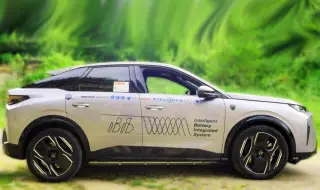
The automotive group Stellantis, in partnership with the French company Saft, part of TotalEnergies, announced the start of road tests of its innovative IBIS (Intelligent Battery Integrated System) technology. This project, which integrates key components of the electric drive into a single module, could be a turning point in the development of electromobility.
What is IBIS?
IBIS is a revolutionary architecture that combines the inverter, the charger and the battery itself in a single compact module. This integration offers a number of significant benefits:
Higher efficiency: Initial tests show a 10% increase in energy efficiency over the WLTC cycle, which means a longer range on a single charge.
More power: The system allows the maximum power of the electric motor to be increased by 15% (from 150 to 172 kW) without changing the battery capacity.
Reduced weight and faster charging: IBIS reduces the weight of the vehicle by around 40 kg and shortens charging time by 15%. This is a tangible improvement for users in everyday life.
Practical application: Peugeot E-3008
The first fully functional prototype equipped with the new system is the latest generation Peugeot E-3008, based on the STLA Medium platform. In addition to improving efficiency and power, IBIS frees up up to 17 liters of interior space. This gives designers more freedom in designing the interior and exterior, while improving the aerodynamics of the car.
The development of IBIS began in 2022 with a focus on stationary applications, allowing the team to test the main technical concepts and patent key ideas. Now, with the transition to a mobile prototype, the technology is proving its effectiveness in real-world conditions. This success is the result of the joint work of Stellantis, Saft and a number of partners, including leading research institutes in France.
Stellantis believes that IBIS has the potential to be a breakthrough not only for passenger cars, but also for commercial vehicles. The simplified architecture of the system facilitates maintenance and allows for more efficient reuse of batteries in their second life cycle, which is important for sustainable development and the global energy transition.