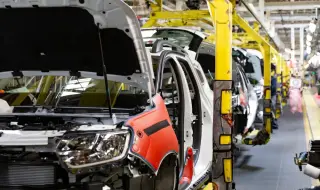
The European automotive sector, and in particular its German locomotive power, is experiencing one of its worst crises in recent history. Against a backdrop of stagnant sales, massive layoffs and a difficult transition to electric vehicles, the industry is struggling to survive and compete. More than 50,000 jobs have already disappeared in Germany alone.
The problems have reached a boiling point, necessitating the convening of a high-profile automotive summit in Berlin, bringing together politicians, executives from companies such as Volkswagen, BMW and Mercedes-Benz, and unions. The main issue is not simply the end of the internal combustion engine (ICE), but the much larger threat coming from the East.
Technological lag and the Chinese invasion
Once dominant in technology and brand prestige, German companies are now lagging behind their Chinese rivals in both software innovation and market adoption of electric vehicles. Chinese giants such as BYD and others are aggressively expanding into the European market, offering more affordable and technologically advanced electric cars.
According to Sander Tordoar, chief economist at the London-based Centre for European Reform (CER), Berlin's defense of the ICE is a "minor issue" compared to the much larger threat posed by China. "China needs a response in the field of industrial and trade policy," he said.
The tension is further complicated by the protectionist policies of US President Donald Trump, which have dealt a further blow to Germany's dominant export sector. In the first half of 2025, European car exports to China, driven mainly by Germany, fell by 42%, while those to the US fell by 13.6%.
The political response
Against the backdrop of the crisis, the German government is looking for a decisive response. Chancellor Friedrich Merz has already called on the European Union to repeal a planned ban on the sale of new internal combustion engine cars from 2035. He described the measure as a "straitjacket" for manufacturers' competitiveness. "We shouldn't ban: We need to enable technology, that's my goal," Merz said.
Despite the lobbying, Craig Maley of Cox Automotive warns that changing the deadline risks undermining confidence in the transportation transition: "Consumers need clarity in this uncertain market environment. Customers need reassurance that electric mobility is the technology of choice." German media reports that the likely compromise to be reached at the Berlin meeting will allow the sale of hybrid vehicles beyond 2035.
The solutions
In view of the “overcapacity and lack of demand for European car production across the continent“, experts are calling for demand-side action.
Finance Minister Lars Klingbeil has already announced an extension of the tax break for electric vehicles in Germany until the end of 2030. Sander Tordoar of the CER believes that the next step should be the introduction of coordinated subsidies for the purchase of electric vehicles across the European Union, citing an effective rebate of up to €7,500 as a possible measure.
Some countries are already taking protectionist measures. France has revised its incentive system (up to €7,000) to exclude vehicles from non-EU countries that are produced with a lot of coal energy - a measure aimed directly at cheaper Chinese models.
The problems of the German car industry are deeply structural and are leading to dire financial results: Mercedes-Benz reported a 56% drop in profit to €2.7 billion in the first half of 2025. Volkswagen saw its operating profit fall by a third to €6.7 billion. BMW reported a 29% drop in pre-tax profit to €4.02 billion.
Between June 2024 and June 2025, the German industry lost nearly 52,000 jobs. Almost half of the companies surveyed described their current situation as “bad” or “very bad“, with nearly 80% planning to postpone investments or move them abroad.
The future is in the union
Despite the gloomy picture, experts do not see the end of the European car industry. Tordoir calls on Brussels to take measures to strengthen the entire European market, as Spain, Italy and France are also losing market share.
“The best way out is to expand our own [European] market, which is still very large and has the potential to generate more demand than it does now,” Tordoir stressed. He added that Europe should use its strong allies - the US, Japan, South Korea and the UK - to form a global strategy against Chinese competition and buy time to adapt, innovate and remain competitive.