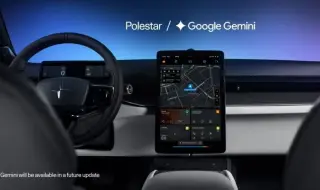
The automotive world is experiencing a quiet but revolutionary change. Electric vehicle (EV) manufacturers are quickly realizing that they cannot win the software war alone. The key to the intelligent car of the future turns out to be Artificial Intelligence (AI), provided by the technology giants. Swedish brand Polestar has taken a decisive step, announcing that it will gradually integrate Google Gemini into all its models, turning it into the brain of the on-board system.
Gemini in the cabin: More than just a voice command
Polestar's plans, detailed by Autoevolution, outline the replacement of the current Google Assistant with the full-fledged AI platform Gemini. This is much more than just a voice assistant update.
The first public demonstration of this integration was carried out in the Polestar 5 fastback sedan during the Slush technology conference in Helsinki. The brand showed how Gemini works directly, implemented in the car, and not as a simple connection to a smartphone. According to Sid Odeder, Polestar UI/UX Director, Gemini will take on the role of the main "digital interlocutor", which will control the car's functions and respond to all the driver's requests.
Evolution of dialogue: From command to natural conversation
The key change that Gemini introduces is the transition from strictly "command" dialogue to real-time communication. Instead of giving precisely formulated commands, the driver will be able to literally "think out loud". Gemini will be able to hold a conversation, understand context, understand explanations and a series of related queries.
This means that communication will no longer be limited to simple requests such as "turn up the volume" or "find directions home". The driver will be able to discuss complex issues, ask for detailed explanations, plan complex trips or learn new things while driving. The car is transformed from a means of transportation into an intelligent mobile assistant, operating at the level of the most modern chatbots.
Why auto giants are capitulating to IT power
For years, most automakers have been stubbornly trying to develop their own assistants. The results, to put it mildly, have been mediocre. Even brands that claimed superiority eventually lost the battle. The reason is simple and obvious: car companies are experts in hardware, design and safety, but they lag drastically behind in cloud technologies, AI algorithms and IT infrastructure.
Several major technology camps are currently forming in the market:
OpenAI/ChatGPT: Volkswagen and Mercedes-Benz are already integrating ChatGPT into their MBUX systems.
xAI/Grok: Tesla, despite its image as a software company, achieved a "normal" assistant only after connecting the external AI project Grok.
Google Automotive OS: For brands like Volvo and Polestar, which already use Google's operating system, the integration of Gemini is logical and seamless.
Google Automotive OS: The new industry standard
The Google Automotive OS (GAOS) operating system is quickly establishing itself as an industry standard. It is used in two main formats:
With Built-in Services (Full Package): Used by General Motors, Ford and Lincoln, Honda and Acura, Nissan and Infiniti, the Renault-Nissan-Mitsubishi alliance with Alpine, as well as Volvo and Polestar.
Without the full set of services (Flexible Package): Preferred by Audi, BMW and Mini, Stellantis, Lucid, Porsche, Rivian. They use GAOS as a flexible foundation, but retain greater control over their own interface and services.
Against this background, Apple seems passive. After the cancellation of the "Apple Car" project and the delay in AI solutions, the company is practically out of the race for on-board assistants. Moreover, experts are even discussing a scenario in which Apple will be forced to use Google Gemini as the basis for an updated Siri.
Advantages and dilemmas for drivers
For EV owners with GAOS, the consequences are obvious: the interface becomes more intuitive and "human". They are no longer tied to memorizing exact phrases, but can explain their tasks in free language.
This is also a winning formula for manufacturers, who receive a ready-made, constantly updated AI tool and can focus their resources on design, chassis and most importantly - safety.
Despite the enormous convenience, however, a delicate issue of data privacy arises. The car becomes a large-scale sensor that collects information about routes, voice requests and personal preferences. When a global IT corporation is at the center of this ecosystem, the balance between convenience and control over one's own data becomes extremely important.
In essence, the car becomes another entry point into the Google ecosystem, changing the very logic of driving - from navigation and multimedia to online services, education and entertainment on the road.