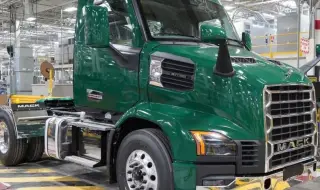
Mack Trucks has ushered in a new era in regional transportation with the official start of production of the completely redesigned Mack Anthem. The machine, which is now rolling off the assembly lines of the Lehigh Valley Operations plant in Pennsylvania, is the result of a decade of engineering innovation and an investment of more than $400 million. Designers have relied on “surgical“ precision to create a tractor that not only looks impressive, but also solves the biggest pain points of the transportation business: high fuel costs and a lack of qualified personnel.
One of the most significant technical improvements is the shortened distance from the bumper to the back of the cab (BBC) — just 288 cm (113.5 in). This change turns the massive Anthem into an unexpectedly agile “city player”, capable of handling narrow streets and crowded loading docks, where every inch counts. At the same time, aerodynamics have been taken to a new level with a wedge-shaped cab and a redesigned hood, which not only reduces frontal resistance, but also improves visibility in front of the truck by as much as 12%.
Under the hood is the powerful MP13 engine with up to 515 horsepower, which works in perfect harmony with the intelligent mDRIVE transmission. The result is impressive — up to 10% fuel economy compared to the previous generation, which, according to the company's calculations, can save carriers about $ 5,000 per year per truck. These results are also helped by patented wave pistons that optimize fuel combustion, turning every drop of diesel into pure thrust.
Safety and digitalization have also received due attention. The Mack Protect system, which is standard on the model, now includes adaptive cruise control and collision warning, while higher equipment levels add curtain airbags and lane keeping assist. In addition, the Anthem is the most connected truck in the brand's history - with the Integrated Uptime package, dispatchers receive real-time data on the condition of the machine, while drivers enjoy a cabin designed with the comfort of a passenger car.