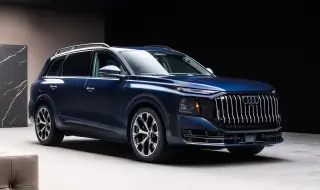
Audi has finally revealed its long-rumored behemoth in the form of the Q9, the largest, most luxurious and uncompromisingly ambitious car to ever wear the four-ring badge. With its impressive dimensions of 5,310 mm in length, 2,210 mm in width and a wheelbase of 3,140 mm, the Q9 dwarfs the Q7 in every dimension. Compared to its smaller sibling, it is around 250 mm longer, 200 mm wider and has a 145 mm longer wheelbase.
Although it shares basic architectural roots with the updated Q7, the Q9 has carved out its own distinctive visual identity. The front fascia is striking with a wide, upright grille framed by vertical slats and a dark frame that flares outwards, forming a menacing smile.
At the rear, designers have moved the license plate mount to the lower part of the bumper to leave a cleaner surface on the tailgate. The real attraction are the curved digital OLED taillights. Made of ultra-thin glass panels that follow the three-dimensional contours of the rear side panels, they offer animated light sequences while significantly improving side visibility after sunset.
According to Audi CEO Gernot Dölner, the future identity of the brand will be increasingly defined by the in-car experience, recognizing that modern luxury cars serve as much more than just a means of transportation. Entering the vehicle through electrically operated doors, capable of opening up to 90 degrees with proximity sensors to prevent collisions, the Q9 reveals a top-class interior. Available in a standard seven-seat configuration or an optional six-seat configuration with individual seats in the middle row, even the third row provides ample head and legroom for adults of average height.
Overhead is an optional 1.5 square meter electrochromic panoramic glass roof that can switch between transparent and opaque in nine separate zones, illuminated by 84 built-in LEDs in 30 customizable colors. The optional Bang & Olufsen with a power of 1,360 watts, including 22 speakers, supplemented by acoustic drivers mounted in the headrests and impulse actuators in the seatbacks that vibrate in sync with the music.
Under the hood, the models for the European markets offer a 3.0-liter inline-six-cylinder diesel engine with a mild hybrid system, equipped with electric turbochargers, which develops 217 kW (299 hp) and drives all four wheels via an eight-speed automatic transmission. North American models are expected to be equipped with a standard 2.9-liter turbocharged gasoline V6 developing 320 kW (435 hp), as well as the flagship 4.0-liter twin-turbo V8 generating up to 441 kW (599 hp). Market launch is expected later this year, along with pricing and more powertrain information.