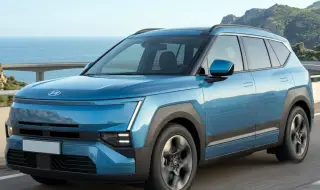
The compact crossover Hyundai Tucson has entered the zone of complete rethinking, preparing for its most significant transformation in recent years. The fifth generation of the popular model retains the dimensions of its predecessor, but categorically says goodbye to the complex geometric breaks and integral lights built into the front grille, with which it became recognizable on world roads. The accumulated information from the test prototypes reveals a clear direction towards a significantly cleaner, but at the same time brutal vision.
The exterior appearance of the transformed Hyundai Tucson relies on strongly emphasized cubic shapes, a flat horizontal front hood, pronounced square fender arches and a visually divided roof. The classic massive radiator grille gives way to a discreet cooling vent, while a light strip combined with vertical turn signals stretches across the entire width of the front. The main light units are positioned low in the outer areas of the front bumper.
A similar design philosophy dominates the rear, where the combination of vertical and horizontal LED elements forms a characteristic light signature. The outlines of the side windows have also undergone correction, giving the car an aesthetic close to that of the larger SUVs in the Hyundai range.
The interior of the cabin balances between advanced digital technologies and ergonomic pragmatism. Two independent screen modules are located in front of the driver, with the central display of the Pleos infotainment system, based on Android, reaching an impressive 17 inches. Unlike competitors that rely entirely on touch controls, Hyundai retains physical rotary buttons for controlling the climate system and volume, making everyday use of the car easier while on the road.
The European modifications put a final end to diesel drives. Their place is taken by a new generation of 1.6-liter gasoline hybrid units with a power of 150 and 180 horsepower, respectively. Separately, the Plug-in hybrid versions report a serious jump in efficiency, providing a range of over 100 kilometers in all-electric mode. Manual gearboxes are completely removed from the product list, and customers will be able to choose between front-wheel or four-wheel drive.
The official debut of the model is expected during the Paris Motor Show in October 2026, with the commercial launch planned for the end of the same year, and the first deliveries to the European market will begin in early 2027.