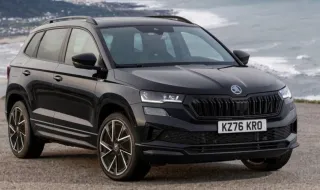
The Czech automaker Skoda has revised its product strategy and decided that the discontinued Karoq crossover that was being prepared will still receive a direct successor. The company's initial intention was to hand over the baton entirely to the electric Elroq, but market realities forced a change of course. The second generation of the bestseller is expected to hit the market in 2027 or 2028, offering customers an upgraded platform and cutting-edge hybrid technologies.
The current Karoq debuted in 2017 and quickly became one of the brand's pillars. CEO Klaus Zellmer confirmed that the new model has already been given the green light for production. The design will continue to be based on the Volkswagen Group's MQB architecture, which guarantees the preservation of the model's characteristic practicality, excellent spatial ergonomics and high interior functionality.
The key innovation in technical terms will be the borrowing of drive systems from its older brother Kodiaq. The main emphasis in the range will be the rechargeable plug-in hybrid, whose battery will provide a range of over 100 kilometers entirely on electricity. The presence of this modification will not only satisfy the demand for flexible cars for long trips, but will also distinguish the Karoq from its related Volkswagen T-Roc, which does not have similar technology.
The sales strategy of the Czechs envisages the new generation Karoq and the electric Elroq to exist in parallel in a similar price segment. The company emphasizes achieving an optimal ratio between final price, level of equipment and everyday utility. In this way, the brand will offer a clear choice to both traditionalists who prefer internal combustion engines and fans of full electrification.
The success of the Elroq, which quickly rose to the top of the electric vehicle sales in Europe, has proven the need for flexibility in the market. According to Klaus Zellmer, adjusting the product portfolio to real consumer demand is the only right move. The new generation Karoq aims to unleash exactly this potential and maintain the brand's high market share.
The retention of the popular model is a clear signal that classic engineering solutions with internal combustion and hybridization continue to play a key role for global manufacturers. More technical details about the final vision and configurations of the second generation are expected to be revealed in stages as its official premiere approaches.