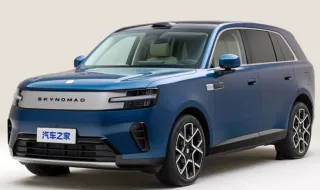
The new energy market in China was shaken by another bold offensive by Xiaomi. The technology giant revealed the official price lists for its new five-seater SUV SkyNomad N70, surprising even the most daring analysts. The base version N70 Pro with rear-wheel drive starts at just 209,900 yuan (approximately 27,000 euros), while the top version N70 Max with four-wheel drive is available from 239,900 yuan (about 31,000 euros).
With these financial parameters, the new addition is positioned significantly below the all-electric Xiaomi YU7, whose starting threshold is 253,300 yuan (about 32,800 euros). The brand's strategy also directly hits the best-selling Tesla Model Y, assembled in Shanghai, whose price starts at 263,500 yuan (about 34,000 euros), as well as the extended six-seater Model YL, reaching 339,000 yuan (about 43,900 euros).
For the first buyers who made a reservation by October 7, the manufacturer is applying an additional package of benefits worth up to 67,000 yuan (nearly 8,100 euros). The financial incentive does not represent a direct reduction in the list price, but includes premium equipment and preferential leasing terms. The choice includes front seats with a swivel mechanism, luxurious upholstery made of genuine Nappa leather, an advanced Xiaomi HAD autopilot system and a built-in refrigeration module for the Max modification.
The SkyNomad N70 uses the EREV (Extended-Range Electric Vehicle) concept - the wheel drive is entrusted entirely to electric motors, and the 1.5-liter gasoline turbo engine with a capacity of 150 hp (112 kW) installed under the hood performs the function of a current generator. Engineers have achieved remarkable reliability, with the ICE service required only once every three years or every 30,000 kilometers.
The base N70 Pro variant relies on a single rear electric motor with a power of 282 hp (210 kW) and a lithium-iron-phosphate (LFP) battery with a capacity of 52 kWh. The autonomy on electricity alone reaches 351 km according to the Chinese CLTC standard, and the combined mileage on a single tank swells to an impressive 1,351 km. With a fully discharged battery, the declared average fuel consumption is only 5.7 liters per 100 km on the WLTC cycle.
The flagship N70 Max adds a second unit on the front axle (100 kW), achieving a system power of 416 hp (310 kW). The larger 76 kWh battery provides 505 km of pure electric range and a total autonomy of 1,461 km (CLTC). The sprint from a standstill to 100 km/h in this version takes only 5.5 seconds.
The second level of equipment also receives adaptive air suspension with electronically adjustable shock absorbers. Despite its impressive dimensions, the crossover demonstrates a turning radius of only 5.67 meters. The wading depth reaches 600 mm for the Pro and 650 mm for the Max.
The external dimensions define a serious presence on the road: length 4960 mm, width 1998 mm and wheelbase 2950 mm. The height varies between 1765 and 1785 mm depending on the suspension. The exterior design is complemented by 19- or 21-inch wheels, and the semi-hidden door handles retain a direct mechanical connection with the locks – a solution that complies with the latest Chinese crash safety standards.
The digital architecture in the cabin is supported by the Qualcomm Snapdragon 8650 chipset, with the driver having a 16.1-inch central touch display, an 8.8-inch odometer and a large 20-inch head-up display (HUD).
For the comfort of the second row of seats, a 21.4-inch monitor that drops down from the ceiling, combined with a mobile 6.88-inch command module, is provided. In the Max version, a 9-liter refrigerator is integrated between the seats.
The front seats offer a massage function, a full rest mode and the ability to rotate 180 degrees to the second row. Thanks to five longitudinal rails in the floor, the seats and the center console can be rearranged freely. The luggage compartment has an initial volume of 1203 liters, which increases to a colossal 2425 liters when the second row is folded.
Safety is guaranteed by nine airbags, an external LiDAR scanner and an Nvidia Thor-U chipset with a computing power of 700 TOPS. The Xiaomi HAD autonomous driving complex seamlessly covers city routes, highway driving, and fully automated parking. In its basic version, the model relies on independent suspension with double wishbones at the front and a multi-link scheme at the rear.