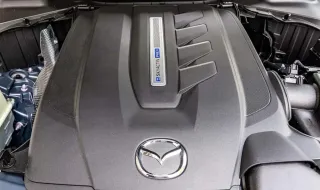
While much of the automotive industry has been feverishly announcing deadlines for full electrification in recent years, the Japanese manufacturer Mazda continues to categorically follow its own and quite different course. In Hiroshima, they have no intention of sending the internal combustion engine into history anytime soon, as they are convinced that fossil fuel propulsion still has serious potential for development.
The company's strategy relies on a flexible approach with multiple parallel solutions, instead of unconditionally relying solely on batteries. According to Moritz Oswald, head of product planning at Mazda Europe, the global market is far from homogeneous, and customer needs, charging infrastructure and energy mix in regions such as the USA and Japan are fundamentally different from those in Europe. That is why the refusal of gasoline and diesel in the short term is defined by the brand as an unjustified move.
With this position, the Japanese brand stands alongside giants such as Toyota and BMW, which also refuse to close the door to conventional units. History shows that the brand has always swam against the current — from the use of atmospheric engines in times of mass tuning with turbochargers, through Skyactiv-X technology, to the iconic rotary engines, which recently returned as a power generator in electric models with extended range.
However, the engineering rebellion does not mean complete ignoring of environmental standards. The Japanese brand is actively developing its next generation of engines, called Skyactiv-Z. The new 2.5-liter four-cylinder atmospheric unit is expected to debut under the hood of the CX-5 SUV at the end of 2027, coupled with the first hybrid system developed independently by the brand. The aim is to achieve maximum thermal efficiency and meet the strictest environmental standards without losing power.
At the same time, the company is not ruling out electric mobility entirely and is using joint ventures in China to launch the all-electric 6e and CX-6e models. By combining hybrid technology, new six-cylinder in-line engines and retaining lightweight sports icons such as the MX-5, the engineers from Hiroshima aim to maintain a balance between environmental requirements and the pleasure of classic driving.