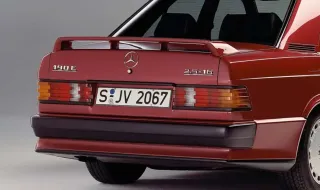
If you have ever looked at classic Mercedes-Benz models from the 70s, 80s and early 90s, you can't help but notice their specific, densely ribbed taillights. Today, these embossed plastics look like a cute retro accent from the era when cars were made with a more raw and honest character, but their appearance is not a simple design whim or a random fashion fad.
German engineers have put an enormous amount of thought and pragmatism into this decision, driven by the pure need to improve road safety. In those years, and not only, the road network in Europe in autumn and winter was often a nightmare of mud, slush, spray and dirt, which instantly sticks to the back of moving cars. When the usual smooth glass or lenses became covered with a thick layer of dirt, the car's taillights would virtually disappear from the view of drivers behind, creating serious conditions for accidents in poor visibility conditions.
To solve this problem, engineers designed the taillight lenses with deep grooves and protruding ribs. This special geometry disrupted the flow and distribution of mud spray so that dirt could not evenly and densely clog the entire area of the lights. Even when the outside of the housing is heavily soiled with dust or road grime, the grooves and relief channels allow the light beam to make its way through the unaffected areas and remain visible to other road users.
In addition to their purely practical function against smudging, these ribs also have a wonderful optical effect, distributing the light homogeneously along the entire length of the lens. With the advent of the era of aerodynamics, smooth surfaces and modern LED technology, the need for such mechanical protections gradually disappeared, but the ribbed taillights remained in the memories of fans as a symbol of that era in which every detail of the car was created with true reliability in the real world in mind.