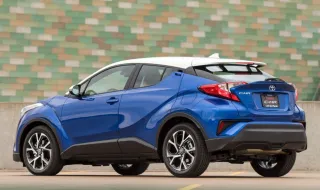
When the Japanese automotive giant Toyota presented its compact crossover C-HR, the stage seemed to be set for an undisputed triumph. The futuristic shapes, broken profiles and aggressive stance promised a breath of fresh air in the brand's otherwise conservative range. However, under the attractive shell of the Coupe High-Rider concept, serious functional and dynamic shadows quickly began to shine through, which turned this bold model into one of the company's most controversial cars in recent years.
The visual concept undoubtedly attracts attention on the street, but everyday life behind the wheel quickly breaks the initial enthusiasm. The massive rear pillars of the body, combined with the high side line and the coupe-like roof, create dramatic blind spots for the driver, which greatly complicate maneuvering in urban conditions. The space for passengers in the second row is a real test for claustrophobic conditions - the small, high-mounted side windows block the access of natural light, and the niche around the hidden external handles is extremely unnatural and uncomfortable for everyday use. The modest volume of the luggage compartment further seals the verdict that style has completely prevailed over practicality.
The situation under the hood is far from offering the sought-after sporty dynamics that the exterior so loudly declares. The atmospheric 2.0-liter four-cylinder unit, coupled with a continuously variable CVT transmission, works extremely sluggishly when trying to overtake more dynamically on suburban routes. Any sharper pressure on the accelerator pedal leads to a monotonous, rumbling whine of the engine at high revs, without this being translated into adequate acceleration. The versions available on the European market with a 1.2-liter turbo engine and the familiar hybrid systems also suffer from a distinct deficit of temperament on a long journey, leaving a feeling of incompleteness among lovers of tighter driving.
The paradox of the Toyota C-HR lies in the fact that this is far from being a mechanically fragile or unreliable car. The traditional Japanese quality of assembly and components remains intact, but the conceptual gap between the boldness on the outside and the grayness under the hood left a bitter taste in the mouth of many of the initial enthusiasts. Ultimately, this crossover shows that even for proven authors on the automotive scene, overly obvious compromises between ergonomics, dynamic performance and aesthetics can quickly turn a bold dream into a subject of serious critical discussions, but the paradox is that despite this, the model sells very well, both in Bulgaria and in Europe.
Drawing the line for the European market, the Toyota C-HR remains a true two-faced phenomenon: on the one hand, it stands out with unwavering hybrid reliability, impressively low fuel consumption in urban conditions, tight road behavior thanks to the TNGA platform and impeccable resale value, while on the other side of the scales weigh the limited trunk, compromised rear visibility, noisy CVT transmission under high load and anemic dynamics on extra-urban crossings.