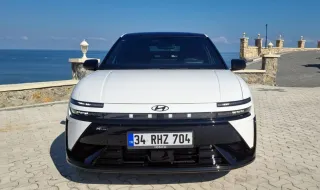
Istanbul, Turkey. Mobile.bg team from the event site.
Given the Chinese invasion and the efforts of European manufacturers in this direction, the challenge facing Korean engineers was extremely complex, but the result is already here. Our team headed directly to Istanbul to get up close and personal with one of the most anticipated electric models of the Koreans - Hyundai Ioniq 3, which will be produced in Turkey, but is designed in and for Europe. Our idea was to find out whether this candidate for the European throne has the necessary weapons to overtake the competition. Here are our impressions.
Exterior
Visually, the Hyundai Ioniq 3 breaks the canons known for the Korean brand. The Koreans stubbornly refuse to call it a standard hatchback or another compact crossover, relying on the definition of “aero hatchback“. Low but with a fairly decent ground clearance of 156 mm and an extremely aggressive wedge-shaped silhouette line, the car was created with one main goal - to cut through the air flow or in other words - to be as aerodynamic as possible.
For this reason, we cannot be angry with the designers for the not-so-"Italian" appearance of the car. The design debuts with the brand's new stylistic philosophy, called “Art of Steel”. Its dimensions of 4,155 mm in length and 1,505 mm in height cleverly position it in the space between city kids and more voluminous family models.
The sharp edges, shaped with geometric pedantry, give the body a dramatic appearance that can hardly go unnoticed in the city flow, regardless of whether you like it or not. In other words, the appearance is quite different from the Koreans' previous compact models, and although it is not in a retro-fun style, like its competitor Renault 4, it impresses with futuristic shapes. We definitely liked it.
Interior
Entering the salon reveals much more than Korean engineering. The architecture of electric vehicle platforms provides interior space that categorically exceeds the external dimensions of the body. Although it rivals the B-segment externally, the interior feeling of spaciousness corresponds to much larger cars. The wheelbase has been stretched to the maximum, moving the second row of seats back and providing generous legroom for passengers.
Although it looks coupe-like from the outside, the roofline retains a relatively flat shape, preventing the space above the heads of the rear passengers from being beveled. The cockpit introduces the new Pleos Connect multimedia system for the first time in Europe. The huge central display offers lightning-fast responses and a logical interface.
The most pleasing fact for any true car enthusiast, however, is the retention of physical buttons. The rotary controls for the climate control and volume, combined with the massive paddles behind the steering wheel, provide a perfect balance between digital entertainment and analog ergonomics. Practicality is complemented by a fairly decent trunk for this class of cars with a volume of 441 liters, which also has an underfloor compartment for storing charging cables.
Engine, battery and driving characteristics
Underneath the interesting exterior lies a modified version of the proven E-GMP architecture. Two options are responsible for the drive. The basic version has a 147 hp electric motor on the front axle and a 42.2 kWh battery, providing about 340 km of range. The high-range version relies on a 61 kWh battery, which promises a range of over 497 km on a single charge and delivers power to the same unit, which is 135 horsepower. The first battery is equipped with cells from the Chinese CATL, and the more powerful one with those from Samsung. Interestingly, the smaller battery provides 12 horsepower more power, but given the same torque of 250 Nm, this difference is almost imperceptible.
The peak charging power is fixed at 115 kW. Connecting to fast charging stations shows a stable filling curve, which ensures relatively minimal downtime at the terminal, although this Ionic is different from the rest of the family. Unlike its larger siblings such as the Ionic 5, Ionic 6 and Ionic 9, which use the expensive 800-volt ultra-fast charging system, Hyundai engineers implemented a special 400-volt version of the E-GMP platform in the Ionic 3. This was done in order to drastically reduce production costs and achieve a more affordable starting price for the end user. Despite being 400-volt, the architecture is excellently optimized - the smart battery design allows charging from 10% to 80% in just 29 minutes.
The suspension uses a semi-independent torsion beam at the rear, combined with specially designed shock absorbers, stabilizer bars and Hankook tires, and the overall feeling is of a tight ride. Behind the wheel during dynamic tests along the coastal roads and various sections around Istanbul, the Korean model showed surprisingly mature behavior, but it is not without its flaws.
Pros:
The steering setup is a unique achievement, especially for an electric car. The steering wheel provides precise feedback, perfect centering and progressive hardening when entering corners. The car responds instantly to every gas application, and the short overhangs create a feeling of direct mechanical connection with the road. The balance in corners (when driving at normal speed) is impeccable, and the agility of the chassis brings surprising driving pleasure. The noise insulation is also at a top level for this class of car.
Cons:
The problem comes at higher speeds and on broken roads. The slightly higher center of gravity compared to some low hatchbacks is felt in the form of a slight lateral tilt during more extreme and fast maneuvers. In addition, as already mentioned, the maximum charging speed lags behind the more expensive 800-volt counterparts in the range, and the suspension's behavior on heavily broken road surfaces leaves much to be desired.
Conclusion and prices
Despite several inevitable shortcomings, the Hyundai Ioniq 3 is a clear signal that the Korean giant has no intention of making compromises on European soil. The car combines an unconventional design, high practicality and handling, which brings true joy to the driver.
The basic versions of the model start at 29,590 euros on the domestic market, while the top versions with the large battery and N-Line equipment level will reach amounts of around 41,590 euros. After everything said so far, we can conclude that this model has all the necessary qualities to become one of the main bestsellers in the electric segment.
On the other hand, one of the most important aspects for the Bulgarian consumer undoubtedly remains the financial balance. Although the Korean company positions the Ioniq 3 as the ideal electric alternative to the popular conventional i20 model in our country, the price difference between the two cars is still there. While the petrol i20, familiar to our domestic market, starts at just over 18,000 euros, the new electric aero-hatchback will be positioned on a completely different level. This makes it an offer for a completely different audience, who are looking for modern technologies and electric drive, but are willing to pay a serious premium for them compared to the familiar ICE B-segment in Bulgaria.