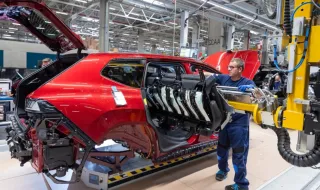
The European car industry is growing concerned about its growing dependence on China. This concerns, among other things, access to rare earth metals, which are needed to produce many components of modern vehicles. Their supplies to Europe depend to a large extent on the decisions of the Chinese authorities. The Association of Distributors and Manufacturers of Automotive Parts (SDCM) warns that the problem is no longer just a potential threat. European factories already felt its effects last year.
China controls 94% of magnet production
The scale of the European car industry's dependence on China is best illustrated by data from the International Energy Agency. In 2024, China accounted for 91% of the world's production of refined rare earth elements, used to make magnets, which are used, among other things, in electric vehicle motors. For sintered permanent magnets, China's share reached 94%.
Let's be clear - magnets are not just for electric vehicles. They are also found in vehicles with internal combustion engines, for example in electric assistance systems, electric windows, etc.
European manufacturers saw for themselves in June 2025 how serious the consequences of limiting supplies could be. The European Automotive Parts Manufacturers Association (CLEPA) then announced the suspension of production lines in connection with Chinese export restrictions.
We recall that in April 2025, as part of the intensification of the trade dispute, China restricted the export of seven rare earth elements, as well as the magnets produced from them. Although supplies were later partially restored, the export of key raw materials still requires obtaining the appropriate licenses from the Chinese authorities. This means that administrative decisions made in Beijing can have a decisive impact on the functioning of factories located thousands of kilometers away.
Chinese parts are flooding Europe. Imports have increased by 23 percent.
Dependence on raw materials is only one side of the problem. European companies must simultaneously compete with an increasing number of finished products imported from China.
According to CLEPA data, in the first half of 2026, the value of imports of car parts from China into the European Union reached a record 5 billion euros. This is 23% more than in the same period last year.
The EU wants to limit imports of Chinese hybrid cars. Beijing refused
In addition, tensions between Brussels and Beijing have been increasing again recently. As reported on October 8 by the “Financial Times“, China has just rejected the EU's proposal to voluntarily limit exports of hybrid cars to the European market.
We recall that the European Commission wanted the share of Chinese hybrid cars on the EU market to be reduced from over 33% to around 15%. However, Beijing did not accept such a decision. Back in September, the Chinese Ministry of Commerce pointed out that voluntary export restrictions would violate World Trade Organization rules and the principle of free competition.
Brussels is now considering unilaterally introducing import limits, exceeding which cars would be subject to additional duties. On the other hand, the EU is insisting on easing Chinese export restrictions on rare earth metals and key minerals.
The chairman of the SDCM (Association of Distributors and Manufacturers of Automotive Parts) warns. Europe must have an alternative to China
According to representatives of the automotive industry, a complete break with cooperation with Chinese companies is not an option. However, the European automotive industry must find a way to avoid a situation in which the production of cars and parts depends on the decision of one country.
The response to the crisis cannot be a complete break with China, but a change in approach. For the industry, one thing is most important: real choice. It’s about having a second supplier, strategic stockpiles, our own production facilities, and the ability to manufacture components close to our factories. The strength of the industry is no longer determined by how many cars and parts we can produce, but by whether we will be able to produce them when the global supply chain begins to break downSDCM points out that Europe must first develop its own capabilities for refining raw materials, producing magnets and assembling components. This does not necessarily mean that all the necessary minerals must be mined locally. It is important that at least some of the processes that are currently carried out almost entirely in China can be carried out closer to European plants.
Paradoxically for Poland, this could mean a chance for new investments in the automotive industry. However, expanding the production base requires time and huge financial investments.
Meanwhile, the outcome of the current trade negotiations could have much faster consequences for European manufacturers. Brussels wants to limit the flow of Chinese cars, but at the same time needs Beijing's consent to more freely export the raw materials needed for their production. This puts the European automotive industry in an extremely awkward position: while trying to protect its own plants from competition from China, it must simultaneously fight for supplies without which those same plants will not be able to operate.