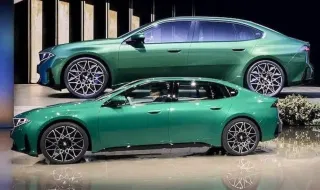
The large-scale market test of the new BMW i3 on Chinese territory caused a real sensation in the automotive industry, after the sedan managed to cover the incredible distance of 1213 kilometers without a single stop for recharging. According to official data from the Bavarian manufacturer, this becomes the longest route ever overcome by their serial electric car in real conditions. A curious detail is that when crossing the finish line, one percent of the car's energy reserves were still recorded.
A specific modification of the model, designated as the i3 50L, took part in the test. It has rear-wheel drive and a specially extended wheelbase of 3005 millimeters, which was officially presented in August at the Chengdu exhibition and was developed specifically for the needs of local consumers. The additional space in the cabin is invested entirely in the comfort and legroom of the rear row passengers. The test drive route itself was as close to real life as possible, combining busy city arteries, dynamic country roads and expressways.
The recorders recorded an extremely modest average electricity consumption of only 8.8 kilowatt-hours per hundred kilometers traveled. However, since BMW headquarters did not publish detailed breakdowns of the average driving speed and the percentage ratio between the different road surfaces, experts urge that the achievement should not be taken as an absolute guarantee of daily mileage in all climate and road conditions.
The technological basis of this success lies in the new Neue Klasse platform and the revolutionary sixth generation of cylindrical cell batteries, the mass production of which has recently started at the Shenyang plant. These modern batteries feature over twenty percent higher energy density compared to previous generations, with the total capacity of the pack for the Chinese market reaching an impressive 113.4 kilowatt hours.
The car's 800-volt electrical architecture supports ultra-fast charging with a peak power of up to 400 kilowatts. This allows, under optimal conditions, just ten minutes of staying at a high-voltage station to restore energy for a new 400 kilometers of range, turning long journeys into a hassle-free experience.
The official start of customer deliveries on the Chinese market is planned for the first quarter of 2027. At the same time, the technical specifications for other regions show serious differences - for example, for the American market, the estimated autonomy is limited to around 753 kilometers (468 miles), which is a completely separate market estimate and is not directly comparable to the record achieved in the Asian country.