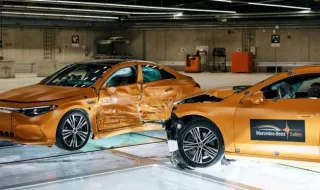
The engineering team of the German premium manufacturer Mercedes-Benz carried out an unprecedented crash test, which pitted two new CLA cars against each other in extremely difficult conditions at an intersection. Without the intervention of braking systems and with an impressive mass of over two tons for each of the vehicles, the CLA Shooting Brake station wagon with an electrified gasoline engine crashed with full force into the side of its all-electric sibling at a speed of fifty-six kilometers per hour.
The large-scale experiment involved the participation of a total of eight high-tech dummies, distributed equally between four adults and four children in both compartments. Analysis of the data collected from tens of thousands of measurement points shows a minimal risk of fatal or serious injuries. The structures of both cars retained their integrity without deformations in the passenger cells, and the high-voltage battery of the electric modification remained completely isolated and mechanically intact.
The choice of such a scenario is far from accidental, since side impacts in an urban environment offer significantly more limited space for absorbing kinetic energy compared to frontal collisions. The speed of fifty-six kilometers per hour exceeds the standard urban limits and reflects the upper limit of severe accidents at intersections, which, according to company statistics, account for about a quarter of all accidents with injuries.
Within the development process, physical tests are preceded by over fifteen thousand virtual computer simulations, supported by artificial intelligence algorithms, after which about one hundred and fifty real crash tests are conducted. The uniqueness of this demonstration lies in the use of two moving production cars instead of the standard passive barriers, which allowed engineers to test the body's response in real road conditions without electronic intervention from the collision avoidance assistance systems.
Along with passive safety, the car giant also presented for the first time the innovative Rescue Intelligence platform, the implementation of which is planned for next year. The system is designed to send critical data to rescue teams during their journey to the scene of an accident. It transmits information about the number of passengers, the status of the restraint systems, open doors, as well as the thermodynamic parameters of the high-voltage battery, which allows medics and firefighters to prepare an optimal response strategy even before their arrival.