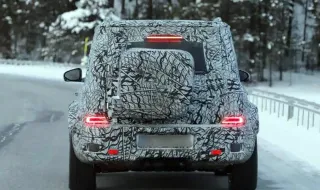
Fans of rugged off-road design and German premium engineering will have to arm themselves with a little more patience. The German brand's long-awaited smaller crossover, popularly known as the Baby-G, is officially delayed to the spring of 2028. That means nearly four and a half years of development from the moment CEO Ola Källenius gave the project the green light at the IAA show in Munich in the fall of 2023. In exchange for this wait, however, important details about the pricing have come to light, with inside sources confirming that the starting price will be approximately half that of the classic large model.
With the price of the standard Mercedes-Benz G-Class in Europe starting at around 125,000 to 140,000 euros for the base versions (and over 180,000-200,000 euros for the AMG / electric variants), the approximate starting price for the compact “Baby-G“ is expected to be in the range between 60,000 and 70,000 euros.
The future addition to the brand's portfolio will take the position of a more maneuverable and affordable alternative with a body length of around 4.5 meters, similar to that of the compact SUV model GLA. Despite its more modest dimensions, the engineers and designers have retained the iconic philosophy of the silhouette. Prototype tests reveal familiar motifs: upright front and rear pillars, extremely short overhangs for a better approach angle, widened fenders and the obligatory cubic element on the tailgate, which serves as a box for a spare tire or additional luggage.
The vehicle's debut will be headed by a fully electric modification, relying on a high-tech drive scheme. The design combines a rear electric motor from the eATS 2.0 series with a two-speed gearbox and a front synchronous motor eATS 1.6 with permanent magnets, and to improve efficiency, a mechanism is provided for automatically switching off the front axle under normal conditions. The innovative 800-volt architecture will allow ultra-fast charging with a power of over 320 kW, ensuring a quick recharge of the battery even during long journeys.
For consumers who still prefer conventional fuels, the German manufacturer is also preparing hybrid alternatives. The basic gasoline-electric version is expected to borrow the 1.5-liter four-cylinder turbo engine with 190 horsepower and 300 Nm of torque from the new CLA, working in sync with an electric motor integrated in the gearbox. Production of the new product line has been entrusted to the expanded Mercedes-Benz production facility in Kecskemét, Hungary, from where the model will begin to conquer global markets.