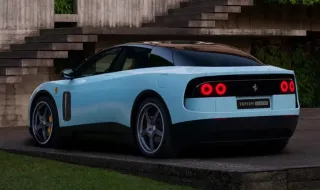
The luxury automotive world rarely witnesses premieres this controversial—simultaneously provoking fierce discontent among fans and breaking demand records, proving the enduring power of the iconic prancing-horse emblem.
The first fully electric car from legendary Italian marque Ferrari, named Luce, has completely sold out its entire planned production volume for the coming year even before the official start of mass deliveries to end customers.
Official confirmation of the market success came personally from the company’s chief executive officer, Benedetto Vigna, during the traditional presentation of the marque’s third-quarter financial results to the respected news agency Reuters.
The management team of the Italian manufacturer from Maranello reports unequivocal interest from collectors and loyal brand enthusiasts, with all units planned for delivery over the next twelve months already fully allocated among customers who placed orders in advance.
Any new customer who decides to order the electric supercar at present will have to be patient and expect to receive their vehicle within a delivery period of at least one year.
The company’s official schedule calls for the first production examples of the Luce to reach their physical owners by the end of the current year, ushering in a new ecological era for the sports-car marque.
Ferrari’s management traditionally keeps the exact production quotas it plans to deliver to global markets confidential, but independent financial analysts from the Financial Times have revealed more detailed figures.
Expectations indicate that during the first year of production, the company will assemble just under 500 units, while its long-term strategy through 2030 envisages a total volume of around 2,500 vehicles, or an average of approximately 600 examples per year.
An interesting aspect of the model’s market journey was the stormy reaction following its official debut in May, when its futuristic exterior, created by star designer Jony Ive, became the subject of sharp criticism and heated public debate.
Despite the purists’ initial skepticism, Benedetto Vigna says that management is extremely pleased with the results achieved and has encountered absolutely no difficulties either with the production process or with end-customer interest.
The marque notes that the initial negative comments are quickly fading, as potential buyers manage to properly appreciate the car’s engineering and proportions when they see it in person rather than in studio photographs.
The major test drives scheduled for next year will undoubtedly attract even greater attention to the exclusive model and cement its image as a supreme technological product.
The electric vehicle’s starting list price has been set at an impressive 550,000 euros, yet even this figure failed to dampen collectors’ enthusiasm, while the first production car, chassis number zero, was sold at a special charity auction for the staggering sum of 40 million dollars.
Under the model’s hood lies a remarkable powertrain with a system output of 772 kilowatts, equivalent to an astonishing 1,050 horsepower.
Thanks to this electric power, the sports flagship accelerates from a standstill to 100 kilometers per hour in just 2.5 seconds, surpasses 200 kilometers per hour in 6.8 seconds and reaches a top speed exceeding the psychological barrier of 300 kilometers per hour.