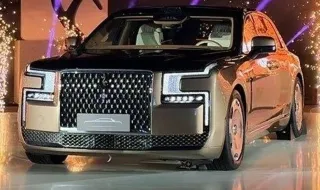
China’s automotive industry continues to demonstrate grand ambitions, but its latest attempt to enter the ultra-luxury segment raises serious doubts and a number of legitimate questions. In Abu Dhabi, Yangwang, a brand owned by giant BYD, unveiled its flagship electric sedan, the Altior. With its imposing dimensions and ambition to compete directly with benchmarks such as the Rolls-Royce Ghost, Mercedes-Maybach S-Class and Bentley Flying Spur, the model is trying to impress with extravagant details such as a 24-karat gold emblem and rear-hinged doors. However, the preliminary price for the limited Shanhe Dingyun edition in China reaches a startling 2.08 million yuan, or around €280,000, calling into question the market logic behind this product.
Even an analysis of the exterior design solutions reveals numerous questionable styling approaches. The massive grille with 137 decorative elements cut to imitate precious stones, along with the hand-applied elongated decorative lines, border on kitsch and excessive ostentation that can hardly fit the refined taste of traditional buyers in this high-end class, especially those in Europe. The sheer scale of the vehicle, measuring 5,600 millimetres in length, and the weight inevitably associated with such massive electric platforms equipped with gigantic batteries conceal serious engineering compromises in terms of dynamics and efficiency under real-world conditions.
The interior, although packed with features such as twin refrigerators, 21-inch ceiling screens and a massive 39-speaker audio system, raises concerns about the reliability of the electronics. The presence of so many complex motorised mechanisms, sensors and software components in the cabin of a Chinese car, even a premium one, creates a high risk of future failures and costly repairs that could quickly turn the luxury experience into a nightmare for the owner. Experience shows that excessive digitalisation and an overload of unnecessary functions often compromise the long-term durability of Chinese cars.
The technological foundation also conceals significant uncertainties and potential risks. Although the e4 platform with four electric motors and the DiSus active suspension promise innovative capabilities such as turning on the spot and scanning the road with cameras, their real-world effectiveness and safety in critical road situations remain unproven by independent tests. Meanwhile, promises of ultra-fast charging that would restore a large part of the battery’s capacity within minutes through a 1,000-volt architecture place enormous thermal stress on the battery cells. This inevitably raises further questions about long-term battery degradation and the safety of the system itself under intensive use.
The biggest problem, however, remains the financial reality and the lack of prestige in this segment. Trying to sell a Chinese electric car for more than €300,000 against established British and German brands with a century-long history is an extremely risky endeavour. Unlike the mass-market car segment, where Chinese manufacturers are beginning to dominate, the luxury segment is built on history, image and impeccable residual value, not merely on a long list of technological extras. But the Chinese apparently have a different opinion. The requirement for a huge deposit of 300,000 yuan just to order the limited edition demonstrates aggressive marketing, which will nevertheless struggle to attract the conservative millionaires of Europe and America, accustomed to the prestige of the European automotive giants.