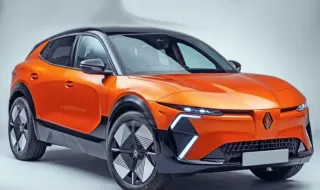
French carmaker Renault is preparing major changes to its iconic Megane model, opting for a radical engineering and design overhaul. The next generation of the car is expected to break with the compromises of the past and offer a range of up to 750 km in fully electric mode, while versions with a petrol generator will achieve an impressive range of 1,400 km.
To date, the current Megane E-Tech has failed to fully live up to the commercial forecasts of the company’s headquarters in Boulogne-Billancourt. Many potential customers were put off by its relatively modest length of 4.2 metres, the limited battery capacity of the entry-level versions and the body’s unconventional proportions. Logically, the company’s engineers have decided that its successor should grow significantly, gaining a more spacious cabin and a silhouette that skilfully balances on the boundary between a classic hatchback and a modern crossover.
The foundation for this major evolution will be the all-new RG EV Medium 2.0 architecture, whose market debut is planned for 2028. The platform is designed for vehicles between 4.3 and 4.8 metres long, with a wheelbase of up to 2.85 metres, while its most significant new feature is the move to rear-wheel drive. According to Renault Group technical director Philippe Brunet, the previous front-wheel-drive layout imposed serious limitations on the precise tuning of the suspension and the car’s dynamic road behaviour, necessitating this bold engineering shift.
In terms of powertrains, the base versions of the new architecture will rely on an electric motor producing around 279 hp and a maximum torque of 350 Nm, while more powerful all-wheel-drive versions featuring two motors are also included in the plans. To ensure high efficiency and a competitive price, Renault is developing lithium iron phosphate batteries with a capacity of less than 90 kWh, which will be integrated directly into the vehicle’s load-bearing structure using cell-to-body technology. Despite the substantial energy reserve, the engineers’ ambition is to keep the car’s total weight below the two-tonne mark.
The target range of the fully electric versions based on the RG EV Medium 2.0 platform is set at 748 km according to the WLTP standard. However, the architecture also has another ace up its sleeve – the possibility of installing a compact internal combustion engine that will function solely as a generator to charge the battery while driving. These extended-range hybrid versions will allow drivers to travel up to 1,400 km without needing to stop at a charging station or petrol station.
Visually, the future Megane will also undergo a major transformation, adopting more aerodynamic forms with short overhangs, a sloping roofline and narrow, aggressive lights inspired by the new Renault Clio. The interior is expected to carry over the bold solutions from the E-Space concept prototype, including the panoramic display spanning the full width of the dashboard, the additional touchscreen on the centre console and the advanced voice assistant. Although Renault has already officially confirmed that the RG EV Medium 2.0 platform will underpin the next generations of the Scenic and Rafale, the final green light for implementing all these technologies in the new Megane has yet to be given.