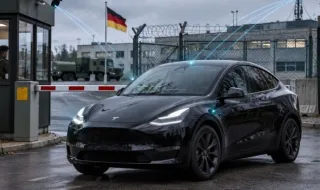
Germany’s armed forces and security services have begun a comprehensive reassessment of the threats posed by modern internet-connected vehicles. Stefan Kramer, head of the Office for the Protection of the Constitution in the German federal state of Thuringia, has issued an official warning that even electric vehicles made by US giant Tesla could become an effective tool for collecting sensitive information. Against the backdrop of these alarming conclusions, the Bundeswehr has already imposed strict restrictions on the access of such vehicles to its strategic military bases.
According to the expert, the fact that an automaker originates from a Western democracy is no longer a sufficient guarantee of technological security. Kramer insists that companies such as Tesla should be subject to the same thorough security checks applied to their Chinese competitors on the market, including giants such as BYD. Despite this firm position, counterintelligence officials clarify that, at present, there is no specific data or evidence that American electric vehicles have been used to deliberately collect intelligence against the German state.
Experts’ main concerns focus on the extensive technological equipment found in modern cars, including dozens of cameras, highly sensitive microphones, advanced radars and a constant internet connection. Combined with built-in navigation systems, these sensors continuously map the surrounding area, record traffic around military facilities, track personnel movements and even capture details of security systems. The collected troves of data can easily be transmitted in real time to remote servers operated by the manufacturers.
In response to these potential vulnerabilities, the Bundeswehr has introduced new security rules restricting the movement of high-tech vehicles near sensitive infrastructure. The measures affect all vehicles with advanced electronics, regardless of their specific brand or country of origin. While entry is completely prohibited in some areas, access to others is permitted only following an individual assessment by the security officers responsible.
Despite the restrictions imposed, there is still no blanket ban on operating Tesla or BYD vehicles on military premises. In practice, owners of such vehicles may park them in specially designated areas located a sufficient distance from classified buildings. Nevertheless, Stefan Kramer recommends that similar safeguards be extended to government institutions, police departments, intelligence services and critical infrastructure sites. Experts also advise government employees to avoid holding confidential conversations inside connected vehicles altogether, as the risk of covert eavesdropping remains real.