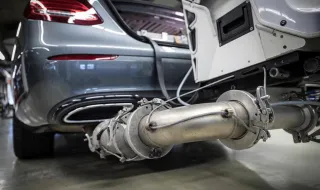
Although the long-awaited Euro 7 regulation does not further tighten the existing exhaust-emission thresholds compared with the current Euro 6e standard, it marks a fundamental shift in automotive regulation. Officially approved by the European Council and published in the Official Journal of the EU, the new legislation will enter into force on November 29, 2026, for all newly type-approved passenger cars and light commercial vehicles, redirecting the focus of European institutions toward previously neglected sources of pollution.
The main innovation in the document concerns controlling fine particulate matter released through brake friction and tire wear. Since forecasts indicate that, with the mass electrification of the vehicle fleet, exhaust emissions will logically fall to a minimum by 2050, tires and braking mechanisms will account for up to 90 percent of all harmful microparticles generated by road transport. For this reason, Euro 7 introduces limits on brake dust, starting at 3 mg/km for fully electric vehicles thanks to their regenerative systems, while the phased introduction of strict limits for tires themselves is also being prepared by April 2032.
For the first time in the history of environmental standards, the legislator’s full attention is also being directed toward electric vehicles, which had previously been exempt from similar requirements. The regulation requires mandatory minimum battery durability thresholds for electric vehicles and plug-in hybrids for the first time. Under the new rules, the battery must retain at least 80 percent of its original capacity for up to 5 years or 100,000 kilometers driven, and 72 percent for a period of up to 8 years or 160,000 kilometers, respectively.
Another significant element of the new framework is the introduction of a digital environmental passport for vehicles, known as the VEP. This official register will collect and store up-to-date data from onboard monitoring systems on actual CO2 levels, fuel consumption, energy efficiency, mileage in fully electric mode, and the condition of the traction battery. The implementation schedule itself provides for a start date of November 29, 2026, for newly type-approved models, followed by mandatory coverage for all new vehicles from the end of 2027, while small manufacturers will receive an extension until July 2030.