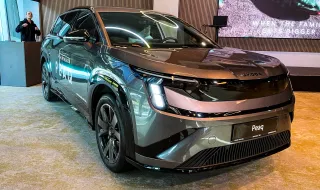
Skoda has added two new electric models to its offerings on the Bulgarian market with the premiere of the most luxurious model in its range, the Peaq, and the more compact Epiq. The two vehicles differ substantially in terms of size, purpose and price. One is a compact urban SUV, while the other is a large family model with seating for up to seven.
Starting with the more compact model, the approximately 4.2-metre-long Epiq uses the MEB+ platform and was developed as a more affordable offering in the brand’s electric SUV range. Visually, the Epiq had the honour of being the first to introduce the brand’s entirely new design language, called Modern Solid. The front end is distinguished by the glossy black TechDeck Face panel, framed by slim, T-shaped LED lights — a light signature that we will soon see on all future SUVs from the Czech brand. For the first time in a production model, the vertical air intakes in the front bumper, known from the Vision 7S concept, also make an appearance.
Engineers from Mladá Boleslav worked extremely hard on the aerodynamics, achieving an impressive drag coefficient of just 0.275 for this class. This was achieved through active cooling louvers behind the bumper, aerodynamic wheel covers and an optimised, completely flat underbody. The dimensions are 4,171 mm in length, 1,798 mm in width and 1,581 mm in height, with a wheelbase of 2,601 mm.
Inside, Skoda remains true to its philosophy of making maximum use of space. Despite its compact exterior dimensions, the interior offers ample room for passengers and a segment-record boot with a capacity of 475 litres, complemented by a 25-litre compartment under the front bonnet (frunk) for the charging cables. A further 28 litres are distributed among storage compartments throughout the cabin. All textile upholstery is made from recycled polyester (PES), while customers can choose between four interior lines (Studio, Loft Grey, Loft Mint and Suite), offering the Techtona leather alternative. The Epiq’s digital centre is the latest 13-inch Android-based infotainment system, featuring completely redesigned graphics, a grid-based app layout and integration of external platforms such as Spotify, YouTube and Google Maps. The physical rotary controls for the climate system below the screen have been retained.
A specific engineering detail is the decision to fit disc brakes on both axles. Since the rear axle does not recover energy in front-wheel-drive versions, the conventional rear brake callipers are used more frequently in everyday driving, completely eliminating the problem of disc oxidation and rust, which is common in many other electric vehicles. Driving in an urban environment is made as easy as possible by full one-pedal control (B mode). However, the Epiq’s major technological trump card is its support for bidirectional charging in Vehicle-to-Load (V2L) mode for external consumers, as well as V2H (to the home) and V2G (to the grid).The Bulgarian price list includes several versions. The most affordable is the Epiq Comfort with 115 hp and a 39 kWh battery. Its price is €25,280. Next is the 135 hp version with the same battery, which costs €29,390 in Selection trim.
The larger 56 kWh battery is combined with a 210 hp electric motor. In this configuration, prices start at €36,460 for Selection and reach €39,420 for Sport Line. Meanwhile, the Sport Line with 135 hp and a 39 kWh battery is priced at €32,290. According to the manufacturer’s data, the range reaches up to 310 km with the smaller battery and up to 430 km with the 56 kWh battery.
At the other end of the spectrum is the Peaq. It is Škoda’s largest production model, with its main focus being space and the ability to carry up to seven people.
The new Peaq is built on Volkswagen Group’s evolved MEB+ platform and is the brand’s first entrant in the large SUV segment. With a length of 4,874 mm and a wheelbase of 2,965 mm, the Skoda Peaq is 116 mm longer than the current Kodiaq. The design allows for three rows of seats, while with five seats in place, boot capacity reaches 935 litres. There is also a 37-litre front luggage compartment (frunk), intended for storing charging cables.
Visually, the Skoda Peaq introduces the new Modern Solid design language, characterised by minimalist lines. The front and rear lights use all-LED technology with a new T-shaped light signature. The model is the first in Skoda’s history to feature retractable door handles and a panoramic roof with an area of more than 2.1 sq m, equipped with Dynamic Shade Control for electronically adjusting transparency. The drag coefficient has been reduced to 0.249 through an active air flap behind the front bumper and optimised aerodynamic elements on the wheels and wheel arches. A curious detail on the windscreen depicts three cyclists, a reference to the brand’s historic Slavia bicycles.
The interior is available in five different concepts (Design Selections), including Suite Black and Suite Ceramique with upholstery made from the environmentally friendly Techtona material. The optional Relax Package includes ergonomic front seats with AGR certification, ventilation and massage functions, leg rests and a built-in table in the centre console. The infotainment system is Android-based and operates through the brand’s first vertically oriented 13.6-inch display. Equipment also includes a Sonos audio system with 16 speakers (755 W) and a Qi2 wireless charger for two smartphones with an output of 25 W.
The model is offered with 63 and 91 kWh batteries and three drivetrain variants. The base version has 204 hp and a claimed range of up to 461 km. Next is the 285 hp modification, which uses the larger battery and offers up to 647 km of range. The most powerful version has two electric motors, all-wheel drive and a combined output of 300 hp. Its claimed range reaches 614 km.
For the Peaq, prices start at €47,890 for the 204 hp Selection version. The 285 hp version costs €54,880, while the all-wheel-drive version costs €57,390.
The higher Sport Line equipment level raises the prices to €53,390, €60,380 and €62,890 respectively.
The two vehicles complement the Elroq and Enyaq, giving the brand broader coverage in the electric segment, while another model is expected to join the range soon in the form of the Combi.