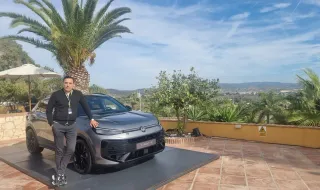
Malaga, Spain. A mobile.bg team on location at the event.
Under Malaga’s southern sun, far from the dry press releases and catalogue tables we have already informed you about, the mobile.bg team managed to take a close-up static look at the new Volkswagen T-Roc R. Although we have not yet tested this car, it is clear at first glance that the most highly tuned version of the second-generation compact SUV does not simply add to the range, but takes the throne as the German manufacturer’s most powerful production crossover for the European market. Seeing the machine in person immediately suggests that the engineers were seeking a balance between the everyday practicality of a high-riding vehicle and the uncompromising dynamics of a sports model, in which the letter R traditionally stands for Racing.
During the inspection of the bodywork, the changes that distinguish this example from the standard versions immediately catch the eye. The front bumper has been shaped far more aggressively, with large air intakes, while the gloss-black accents add contrast and sharpness to the silhouette, and the rear diffuser and four exhaust tips emphasise its sporty character. The blue brake calipers are visible behind the standard 19-inch wheels, but when looking over the cars on display, one immediately starts considering the list of options, which includes 20-inch forged wheels and a titanium Akrapovič exhaust system for those who want a more expressive sound and lower unsprung weight.
Opening the door reveals an interior entirely dedicated to dynamic driving, without losing the feel of a modern digital cockpit. The sports seats with R logos and blue stitching provide firm lateral support, while in front of the driver is a special steering wheel with shift paddles and a distinctive blue R button for quick access to the sharpest settings. The Digital Cockpit Pro instrument panel is not limited to basic readouts, but offers a GPS lap timer, lateral and longitudinal G-force readings, shift prompts and a graphic showing the distribution of torque between the wheels.
However, the car’s true essence lies under the bonnet and in its drivetrain architecture. At the heart of the T-Roc R is the familiar yet refined 2.0-litre four-cylinder turbocharged petrol engine from the EA888 evo5 family, developing 333 hp and 420 Nm of maximum torque, delivered from as low as 1,900 rpm. For the first time, a model from the sporty R family receives a 48-volt mild-hybrid system with a belt-driven starter-generator, which recovers energy during braking and when the accelerator pedal is released. In addition, an electric compressor assists the variable-geometry turbocharger at low revs, minimising turbo lag during sharp acceleration.
When all this thrust is channelled through the seven-speed DSG transmission and 4MOTION all-wheel drive, the figures on paper look impressive. The sprint from a standstill to 100 km/h takes five seconds, while the top speed is electronically limited to 250 km/h. In the bends, a key role is played by the R-Performance Torque Splitter, which can distribute torque independently between the two rear wheels, changing the car’s behaviour and opening the door to Drift mode.
Standard equipment includes DCC adaptive suspension, progressive steering and an enhanced braking system, while the engine, brakes and chassis have been fine-tuned on the track. Particularly intriguing is the Special mode, configured specifically for the demanding profile of the Nürburgring’s Nordschleife. Pre-orders for the new Volkswagen T-Roc R are already open in Germany, with a starting price of €59,995, and the first encounter with the car in Malaga shows that the German brand is aiming high on emotion in the compact SUV segment and has not yet completely given up on internal-combustion engines.