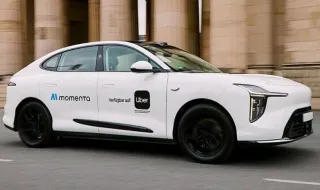
Free rides in an autonomous taxi sound like an enticing offer for any urban traveller, but in the Bavarian capital Munich, the futuristic launch conceals strict legal frameworks and one particularly curious detail. Uber and technology developer Momenta have officially launched their first robotaxis on the streets of Munich, with the service now available to book directly through the platform's standard mobile app. At this stage, customers pay nothing for the rides, although a person is still behind the wheel of every vehicle, keeping a close eye on what is happening on the road without intervening unnecessarily.
The pilot project covers the northern districts of the city, including the busy areas around the Olympic Park, and does not require users to download additional apps. Passengers registered for the programme simply need to be within the designated test area and select a familiar option in the Uber app – UberX, Electric or Comfort. The system determines suitable pick-up and drop-off points, and after the ride is confirmed, a vehicle equipped with artificial intelligence software from the Chinese company Momenta sets off to collect the customer.
The absence of fares during the initial stage is not merely a marketing gesture, but a direct consequence of Germany's demanding rules for testing autonomous systems on public roads. At the same time, full autonomy remains conditional in practice, as the permit to test Level 4 technologies issued by the German Federal Motor Transport Authority (KBA) requires a person to be present in the cabin.
That is why a specially trained employee sits in the driver's seat of every such taxi, whose sole task is to continuously monitor the operation of the onboard electronics and keep the system running throughout the journey. Well, it is free, and one can at least say that insurance against the software's unforeseen quirks is definitely in place.
Uber makes no secret of its ambitions behind the launch, with Samarth Kedjriwal, who is responsible for autonomous mobility operations at the company, highlighting the team's pride in launching Munich's first pilot programme for controlled passenger transport using autonomous cars. According to him, this is a key step towards establishing this type of urban mobility.
The technology partner also emphasises the value of real-world traffic over laboratory simulations. Momenta's Robotaxi unit general manager Shuo Xie noted that building a fully fledged autopilot requires algorithms capable not only of recognising the road, but also of correctly interpreting complex traffic situations. As a representative of the Chinese company points out, every new kilometre travelled helps improve these systems.
Meanwhile, Uber is collecting feedback from its first customers directly through the app and intends to expand the pilot area to other parts of Munich. Thus, the Bavarian city is becoming the latest testing ground intended to prepare the way for the broader introduction of autonomous taxis in Germany.