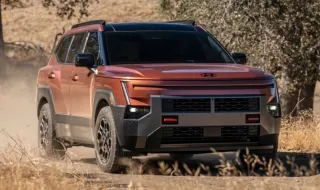
Following its world debut in early October, the fifth-generation Hyundai Tucson now has full technical specifications for the North American market, where the crossover will arrive first in early 2027. The Korean bestseller has grown in every dimension, gained a more expressive stance, a richer package of electronic assistance systems and an all-new multimedia system, while the gasoline and hybrid powertrains are joined by the adventurous XRT Pro version. When one of the world’s best-selling SUVs enters a new generation, expectations are always high, and here the changes go far beyond minor cosmetic refinements.
The exterior of the new Hyundai Tucson is built around the brand’s Art of Steel design language, which emphasizes muscular fenders, pronounced body creases and a distinctive lighting signature. The two-level headlights with original LED elements make an impression at the front, while the rear lights form the distinctive Prism Rear Lamps pattern. Against the more rounded shape of its predecessor, the new crossover looks more muscular and confident, while new color shades for the palette reinforce the impression of a mature and purposeful design.
The increased dimensions bring tangible benefits for interior comfort and cargo capacity. The body length has increased by 58 mm to 4699 mm, the width has grown by 41 mm to 1905 mm, and the height without the roof rails reaches 1684 mm, with a wheelbase of 2784 mm. Thanks to the more generous proportions, passenger and cargo space have been expanded, while the rear doors now open to 83 degrees instead of the previous 73 degrees, making entry and exit far more convenient in tight urban environments.
Inside, the architecture has been completely redesigned with a two-level dashboard, a large open storage shelf and a transmission selector moved to the steering column. Fortunately, Hyundai’s Korean engineers have not succumbed to the trend of hiding everything in menus – physical buttons and rotary controls for the climate system and audio have been retained, so the driver does not have to take their eyes off the road for every adjustment.
The technological centerpiece of the cabin is the Pleos Connect multimedia system, built on the Android Automotive platform. Depending on the equipment level, it is offered with a 12.9- or 17-inch touchscreen, while a 9.9-inch digital instrument cluster is positioned in front of the driver. The system supports over-the-air updates, third-party applications and the Gleo AI voice assistant, which recognizes requests in natural language.
For those who prefer conventional powertrains, Hyundai is preparing gasoline versions with a 1.6-liter turbocharged engine developing 184 hp and 264 Nm of torque, paired with an eight-speed automatic transmission with a torque converter. The hybrid versions use the TMED-II system with the same 1.6-liter turbocharged gasoline engine, a 64-hp electric motor and a 1.49-kWh battery. Combined output reaches 233 hp and 380 Nm, delivered through a six-speed automatic transmission, while the estimated average fuel consumption of the most economical versions is around 5.6 l/100 km, according to the brand’s preliminary figures ahead of the final EPA certification tests.
The hybrid version also adds the E-Traction system for changing torque distribution when cornering, as well as the Stay Mode function, which allows the air conditioning, heating, audio system and device charging to operate for up to 30 minutes while the gasoline engine is switched off. In addition, the hybrid’s maximum towing capacity has been increased to 1360 kg, expanding its practicality for trips outside the city.
The Hyundai Tucson XRT Pro is attracting the greatest interest among off-road travel enthusiasts. It comes as standard with all-wheel drive, 211 mm of ground clearance, 18-inch wheels with off-road tires, front tow hooks and protective body panels. The model is the brand’s first to feature the X-Trek+ system, which assesses the difficulty of the surface and warns of the risk of getting stuck, as well as Target Speed Control for automatically maintaining a set speed of up to 24 km/h over challenging terrain while the driver controls the direction.
Other new electronic aids include an automatic reverse-driving function with memory of the route already traveled and Ground View Monitor cameras, which display the terrain immediately in front of and beneath the vehicle. The gasoline-powered fifth-generation Hyundai Tucson will enter U.S. showrooms in the first quarter of 2027, while the hybrids and XRT Pro will follow at the beginning of the second quarter. Prices and specifications for other markets are yet to be announced.