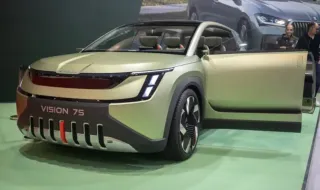
Under the spotlights at an auto show, a concept car looks like a promise of the future. Once the stand is dismantled, however, its fate is often far more prosaic. Some prototypes are placed in manufacturers’ collections, others continue to serve as test vehicles, while still others are dismantled or destroyed.
The reason is that not every concept car is built to be driven. Some are full-size design models with impressive interiors, dashboards and bodywork, but without a functioning engine or transmission. Others have wheels and individual functional systems, but cannot move under their own power.
“Many concept cars are not even technically cars,” says Dan Bedor, a former Nissan public relations representative. Some are built on a plywood and aluminium frame, while the bodywork is made of fibreglass that is not designed to withstand years of temperature changes and moisture.
The most important models are usually kept in private collections belonging to car companies. Mercedes-Benz, BMW and Ford preserve vehicles that have marked a particular stage in the development of their design or technologies. They may be displayed at anniversary exhibitions, special events and museum exhibits.
Other prototypes become engineering test vehicles. They are used to evaluate experimental systems, materials and components before they are potentially incorporated into a production model. Even if a car has a working engine and transmission, that does not mean it can be registered. In many cases, it lacks crash tests, the necessary safety equipment or compliance with emissions standards.
Storage is not cheap either. One-off parts, complex electronics and non-standard materials require special maintenance. Added to this are the costs of space, the risk of damage and the responsibility involved in the potential sale of a vehicle that is not intended for road use. When a prototype is no longer needed, the manufacturer may dismantle or destroy it. This limits costs and prevents untested technologies, experimental components or confidential solutions from leaving the company.
BMW’s recycling and dismantling centre in Germany processes several thousand pre-production vehicles every year. These are primarily test models that cannot be sold to customers. Usable components are separated for reuse, while the materials are sent for recycling. There are also happier exceptions. The 1955 Lincoln Futura was transformed into the original Batmobile for the 1960s television series “Batman.” In 2024, General Motors donated a neglected 2001 Pontiac REV to the Pontiac Transportation Museum after the one-off prototype was discovered in a scrapyard. In November 2026, Ford showed the other side of this story. The company opened its new Vault in Michigan – a space housing 125 historic vehicles, including the Ford Reflex concept car. Thus, a concept car can become a museum relic, a working tool or simply a pile of separated materials. Its fate depends on its construction, its historical value and whether the manufacturer sees it as part of its past or as a prototype it no longer needs.