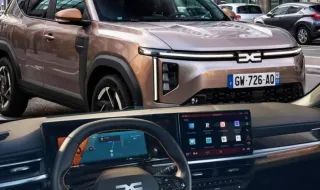
The unexpected withdrawal of buyers in France and the aggressive invasion by Asian brands have placed the Romanian marque in an unusual situation. While for fifteen years the first two generations of the iconic Duster SUV enjoyed enviable market comfort thanks to their winning formula of low price, solid practicality and genuine off-road capabilities, the current edition is facing serious obstacles. January’s statistics are merciless – registrations on French soil, one of the model’s key markets, have plunged by as much as 41 per cent year-on-year, falling from nearly 15,000 to just 8,842 units sold.
There are several reasons for this sharp loss of momentum, but the most painful blow is actually coming from within. The arrival of the larger Dacia Bigster has literally eaten into the audience of the more compact model. For a perfectly reasonable extra cost, customers get a noticeably roomier cabin and a more capacious luggage compartment, prompting many traditional fans to redirect their budgets towards the larger vehicle. On top of that, Chinese competitors such as MG and Jaecoo are cornering the model with their hybrid offerings, which, at similar price levels, tempt buyers with far more generous standard equipment and a more modern atmosphere on board.
The Romanian manufacturer continues to rely entirely on its familiar petrol, LPG and hybrid configurations. There is unlikely to be a revolution under the bonnet with the upcoming update either, as the current range of powertrains – including LPG, mild-hybrid and full-hybrid systems – is modern enough and will most likely undergo only fine-tuning.
Instead of investing in new powertrains, the company’s management plans to rethink its long-standing philosophy of a spartan interior and budget plastics
In order to regain its lost ground in 2028, just four years after the debut of the current generation, the new Dacia Duster will look for inspiration in the East. The new Renault Duster, developed specifically for India, is being cited as the direct benchmark for the cabin’s transformation, as the model is positioned in a higher price segment than its European counterpart.
The Indian variant impresses with a far more modern dashboard, a larger central multimedia screen and noticeably higher-quality materials to the touch. Since the two vehicles share a common technical architecture, transferring these improvements to the European Dacia Duster would not require an expensive redesign from scratch, although headquarters is still keeping silent and has not officially confirmed such an interior transformation.
When it comes to the exterior, however, a genuine visual metamorphosis is expected
The new look will move the crossover away from its current appearance. According to preliminary forecasts, the design will draw bold stylistic ideas from the Dacia Striker, with the emphasis falling on a completely redesigned front end featuring a new lighting architecture and a more muscular bumper. It is highly likely that a slim horizontal LED strip will be positioned beneath the bonnet’s leading edge, complemented by vertical light signatures at the ends, an illuminated brand badge in the centre, integrated main headlights and a massive trapezoidal air intake in the lower section.
To avoid unnecessarily inflating the costs of the modernisation, engineers will most likely leave the expensive-to-produce body panels, such as the bonnet and wings, untouched
The same economic logic will also limit changes at the rear, where the shape of the tailgate will remain unchanged. There, the modifications will be limited to refreshed taillights with vertical elements extending lower towards the base of the tailgate, as well as the addition of new alloy wheel designs.
Of course, at this stage all details surrounding the updated 2028 Dacia Duster remain in the realm of informed predictions, as the manufacturer has made no official announcement. One thing, however, is certain – this will be more than a cosmetic refresh: it will be a deep and strategic facelift of the third generation, with which the brand will attempt to halt the loss of customers without developing an entirely new vehicle.