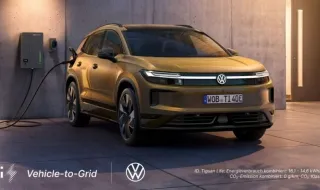
Because the energy grid needs a flexible buffer and electric car owners often leave their vehicles idle at home, Volkswagen Group is launching an unusual initiative in Germany. From December 2026, its subsidiary Elli will pay up to €60 per month for connecting a compatible electric vehicle to a home charging station, amounting to as much as €720 per year. In practice, this means the car can generate income without having to be plugged in for another charging session.
The project is based on Vehicle-to-Grid technology, or V2G for short, in which the flow of energy is not one-way. Unlike conventional charging, electricity can travel in both directions here – from the grid to the vehicle, but also from the battery back to the wider power grid to help stabilise it.
Initially, however, the focus is not on the actual transfer of electricity but on the vehicle's presence in the system itself. A payment of €0.24 is made for every hour during which the electric vehicle is connected to the Elli BiDi Charger, provided that the particular session lasts at least three hours. To reach the monthly cap of €60, the vehicle must remain connected for a total of 250 hours per month – roughly eight hours a day.
Interestingly, at the beginning, the bonus will not require any actual return of electricity to the grid. It is enough for the battery to be available to the energy system, even without any electricity actually being transferred. According to Volkswagen's calculations, the maximum annual bonus of €720 would cover the electricity costs for travelling around 15,500 kilometres in an ID. Tiguan Life, based on a calculated electricity price of €0.33 per kilowatt-hour.
At a later stage, Elli intends to add a separate payment for energy returned to the grid. To this end, the V2G Return tariff is being prepared, with a rate of €0.40 for every kilowatt-hour transferred, but this mechanism will not yet be active when the programme launches.
All management will be handled through the Elli BiDi V2G app. Drivers will be able to set when their next journey is due and what minimum charge level should remain in the battery, while the system itself will decide when to charge and when to use the available capacity for the needs of the grid, without interfering with the set limits.
To join the programme, drivers must install the bidirectional Elli BiDi Charger, which costs €1,995 in Germany, including tax and delivery. The installation itself is paid for separately and depends on the condition and specifications of the home's electrical system. The device operates with direct current, supports up to 11 kW and is compatible with both 400-volt and 800-volt vehicle architectures, and can be installed either indoors or outdoors.
The range of eligible vehicles includes suitable electric models from Volkswagen, Cupra and Skoda, as well as Volkswagen commercial vehicles. The brand alone is not enough, however – the specific model and support for bidirectional charging are decisive. According to Volkswagen, there are already more than one million electric vehicles on the MEB platform in Europe with the technical capability for bidirectional exchange, including around 360,000 in Germany, but this does not mean that all of them will automatically have access from day one.
In addition to a compatible car and bidirectional charger, participants will also need a smart meter, and the technical connection requirements must be checked and an individual installation quote requested before placing an order.
Alongside the V2G programme, Volkswagen is also developing the Vehicle-to-Home solution, known as V2H, through which the electric vehicle's battery will power the home itself. A one-year test involving 20 households has already been completed in Germany, during which the equipment went through more than 6,500 charging and discharging cycles. A separate V2H system is expected in 2027 and will be particularly useful for households with solar panels that want to store excess solar energy in the car and use it later. Following the launch in Germany in December 2026, the V2G programme is also planned to be expanded to other European countries in 2027.