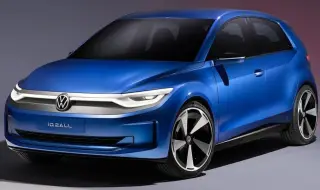
Volkswagen is preparing to make a real breakthrough in the field of affordable electric vehicles by introducing a new battery technology that will significantly reduce the price of series models. The first model to receive new-generation batteries will be the compact electric car ID.2, whose official debut is planned for next year. The price of this model is expected to be under 20 thousand euros, which will make it one of the most affordable offers among European electric cars.
The ID.2 will debut with a new platform called MEB Plus, which is an evolutionary development of the already familiar MEB architecture currently used for most of Volkswagen's electric models. The main difference lies in the new type of battery - instead of the expensive nickel-manganese-cobalt (NMC) cells that currently dominate among Western automakers, the new platform will use lithium-iron-phosphate (LFP) batteries. Despite being weaker in terms of energy density, LFP batteries have a key advantage - a significantly lower price and, therefore, better accessibility for the mass buyer.
As Volkswagen notes, lithium iron phosphate technology, which is already widely used in China due to its cost-effectiveness, will significantly reduce production costs not only for the ID.2 model, but also for the entire model range of the brand. In the future, the transition to LFP batteries is also expected in popular electric vehicles such as the ID.3, ID.4 and ID.7, which will open the way to lower prices for the entire line and make it significantly more competitive compared to other market participants.
At the same time, the new MEB Plus platform will be accompanied by a complete redesign of Volkswagen's electric cars. This will include both external changes and modernization of the interior and digital architecture. In this way, the company plans not only to reduce prices, but also to provide customers with a renewed aesthetic and technological freshness that will meet modern expectations.
In addition to Volkswagen, other major automakers are already actively switching to the use of LFP batteries, including Tesla, General Motors and Ford. This shows a global trend towards the popularization of affordable and reliable electric vehicle technology, which has the potential to make the transition to electric propulsion a mass phenomenon.
It is clear that the launch of the ID.2 and the subsequent introduction of LFP technologies into the wider Volkswagen model range is not only a technological step forward, but also a strategic response to market requirements, where price increasingly determines success in the electric vehicle segment. Given that the current price of Volkswagen's ID models is often perceived as too high, the transition to a new platform could fundamentally change the balance of power, especially in the European electric vehicle market.