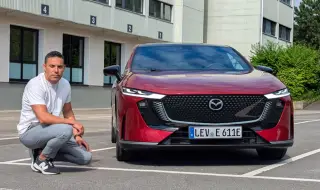
Leverkusen, Germany, mobile.bg team from the event site.
We have repeatedly told you about the different design trends in the automotive industry, but unfortunately, over time, the design of cars is becoming more and more uniform. However, the Japanese from Mazda have gone in a different direction, who showed us their latest product, the Mazda 6e. The design trend in cars, characterized by a reverse slope of the front, is often called "shark" or "shark nose". This stylistic element, popularized by some classic models, has now been resurrected by the new Mazda 6e. And both at the front and at the back. It is this technique that gives the car an aggressive and dynamic look, reminiscent of a predator ready to attack.
Instead of the traditional vertical or slightly forward-leaning grille, the "shark nose" front part leans back, creating a feeling of speed and drive, even when the car is at rest. The Japanese combine this design with a long hood and narrow headlights, which further emphasizes the elegance and sporty character of the vehicle, turning it into a new icon of this automotive style.
This is what the new Mazda 6e looks like – the rear-wheel drive electric liftback that replaces the venerable Mazda6 sedan and wagon range, which will end production in 2023. The "six" model has been a landmark for Mazda, with over four million units sold since the original was launched in 2002.
This latest generation is the result of a long-standing partnership between Mazda and Chinese car giant Changan. It will be built in China for the European and British markets. The 6e's chassis is shared with other local Changan models and features a hybrid system designed specifically for the Chinese market to accommodate a petrol engine in the front. Mazda states that all 6e models intended for Europe will be electric only, but given new trends, it is not excluded that we will see a gasoline range extender version in our country in the future.
What's new?
Everything, in a word. This is only Mazda's second full-fledged electric car, and it is completely different from the unsuccessful MX-30 crossover, even if it tries to resemble it. As mentioned above, to gain an advantage in the electric vehicle market, Mazda is leveraging its long-standing partnership with Changan to develop the 6e model based on the same hybrid platform that underpins the Deepal L07.
A brief look at the Changan brand shows that it is the third largest automobile giant in China, with 14 production bases and 33 factories worldwide. Changan Mazda was established in 2005 as a joint venture with Ford for internal combustion engines. In 2007, production of the Mazda3 began in China for the domestic market, and five years later, special production of the Mazda for the Chinese domestic market began. Deepal is Changan's electric vehicle division, which means that this is not the result of a random "night flirtation" – Mazda and Changan are long-time partners.
At first glance, the Mazda 6e certainly looks like a real Mazda, despite its shared hardware. It has instantly recognizable Kodo design motifs - round taillights (third-generation RX-7), cleanly sculpted side parts and piercing thin headlights. But if you drive around it a few times, you'll notice something odd about its proportions that makes you tilt your head and squint. It looks like a Mazda designed by a pretty smart artificial intelligence. That's good, right? Especially with the reverse rake of the rear and front in the "shark" style.
Mazda's engineering team claims to have had full control over the 6e's suspension, steering and brakes to ensure it possesses the company's trademark – Jinba Ittai ride and handling qualities. Because in the words of Mazda's specialists: “The joy of driving is not up for debate".
What are the specifications?
Two versions are planned for Europe: a modification with the direct name "standard range" and an extended range variant, both of which are expected to use the familiar Takumi (lots of equipment) and Takumi Plus (even more equipment) equipment levels. The standard range version is equipped with a 68.8 kWh lithium-iron phosphate battery, which in the WLTP test is enough for a range of 478 km. It powers an electric motor generating 254 hp and 320 Nm of torque for acceleration from 0 to 100 km/h in 7.6 seconds and a top speed of 175 km/h. The maximum DC charging speed is 165 kW, and the claimed 10% to 80% charge time is just 24 minutes.
The long-range model gets a larger 80 kWh lithium-nickel-manganese-cobalt-oxide battery, which increases the WLTP range by an additional 72 kilometers – handy, if not quite revolutionary. However, the battery can only handle 90 kW DC charging, increasing the 10% to 80% charge time to 47 minutes. It powers an engine that is 12 hp less powerful than the standard-range model (torque remains unchanged at 300 Nm), resulting in an imperceptibly slower 0-100 km/h acceleration time of 7.8 seconds and the same top speed of 171 km/h. Both models weigh 1,962 kg.
All this means that you can get a little further down the road with the more expensive and lighter Long Range, but then you will have to sit in recharging mode for a lot longer. This can logically lead to the conclusion that the cheaper modifications are the better choice.
How does it drive?
Much better than you expect. The driver's position is typical of today's electric platforms – the driver's seat feels five centimetres higher in its lowest position, and similarly the adjustable steering wheel could do with a few centimetres more travel in either direction. But the seats themselves are very comfortable and provide good support, and the pedals are perfectly positioned.
At city speeds the 6e is impressively smooth and refined. The cabin is very well insulated from wind and road noise, with only a dirt road breaking the luxurious, cocoon-like atmosphere. The calibration and weight of the pedals are impressive – there's an immediate and reassuring grip from the first centimetre of brake pedal travel, and the long travel of the accelerator pedal ensures a smooth linear increase in speed. It only takes a few minutes in stop-and-go traffic to realize that this car has the smoothest stopping and starting.
The steering wheel is slightly sensitive (but this is typical of any mass electric car), but here at least it is smooth, linear and with only 2.5 turns between the extreme positions it is pleasantly direct. Acceleration to 100 km/h in under eight seconds may seem a bit slow in these strange times of electric cars, but the 6e always feels like a spirited car, cutting through slower traffic with addictive ease.
Start pushing a little harder on some winding country roads and the 6e will show impressive body control. It takes fast corners cleanly and calmly and changes direction with pleasing clarity for a two-tonne family transporter. And the powerful brakes – 310mm ventilated at the front, 306mm solid at the rear – can be pushed really hard, right up to the point where the anti-lock braking system kicks in.
Energy consumption on our test route was decent, but no more, with the 6e generating 15.87 kWh per hundred kilometres, which is excellent for a five-metre electric car. The only thing that annoyed us was the Mazda's very stiff suspension, which jolts the passengers and sends shivers through the cabin when going over potholes. However, we'll have to postpone our final verdict until we see how it handles the uneven, broken asphalt in Bulgaria.
And what about the interior?
We drove the top-of-the-range Takumi Plus trim level, and its natural-colored suede and complementary leather look and feel great, giving the cabin a soft touch. Combined with the very generous trim levels – full-length panoramic roof, cooled and heated seats, air conditioning for rear passengers, excellent Sony sound system - Mazda creates the feeling that it is well above its level in its sector.
While there's decent space front and rear for four passengers - the back seat would be uncomfortable for a fifth passenger sitting centrally. And the cabin doesn't feel as spacious as you'd expect, given the 6e's 4,921mm length and extended 2,895mm wheelbase. The same goes for the 466-litre boot, which is surprisingly shallow. There is, however, a 72-litre front trunk (frunk) with an optional built-in basket, perfect for charging cables and a few soft bags.
Although the glass roof ensures that the cabin is always bright and open, rearward visibility is surprisingly poor. The slope of the rear window means that the driver has a limited, letterbox-like view. It's a good thing that the 6e's high-resolution cameras provide an exceptionally clear image on the central screen during low-speed maneuvering.
But perhaps the biggest problem for hardcore Mazda fans is the driver interface. All those fancy buttons and analog dials that current Mazda drivers enjoy are gone in the 6e, replaced by a sleek and high-tech central screen that we liked. It's just that there are too many programming, setting and adjustment options that create an initial difficulty, but once you get used to them, everything falls into place. The built-in voice assistant, which speaks like a real person, is a perfect helper, but it looks very untypical for Mazda.
There are also many other "shiny" technological things that may be a dream for most drivers, but not for all. You know what we mean. Gesture control – for the first time in Mazda – is available if you want, as are a series of landscape modes that prepare your car for a car wash, open your windows for fresh air, and a host of other less useful ones, probably aimed at drivers waiting for their model to recharge.
There are even cameras that check the cabin for children and will remind you of their presence if you forget them. You can create a variety of widgets to display on your home screen. You can use the Mazda app to give three of your friends keyless access to your 6e.
Before you buy (equipment levels, prices and competitors)
With a price in Bulgaria of 80,000 leva including VAT (currently offering a 6,000 leva eco bonus), the 6e electric car enters the nest of serious competition, including the Tesla Model 3, BMW i4, Polestar 2, Hyundai Ioniq 6 and the truly strange Kia EV4. But the price is much more attractive than that of the competition, the car is bigger or in other words - it's definitely worth it.
And this, despite the firmer ride, smaller trunk and annoying for some button-less interface. This Mazda should prove attractive to buyers with its combination of elegant looks, decent mileage and generous equipment levels. How Mazda's marketing department will position the model with a longer mileage higher in the price range, however, will be interesting to see. For us, the cheaper option is better.
Verdict
Mazda's first electric car, the MX-30, wasn't exactly what we expected, and maybe the second one is a bit odd, but it's definitely remarkable. The partnership with Changan allows Mazda to bring the 6e to market much faster than if the development and engineering had been undertaken independently. And as we well know, the Chinese connection is definitely a plus when it comes to electric vehicles.