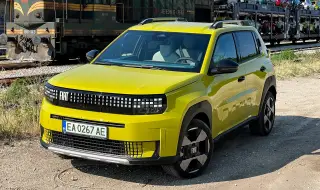
In recent years, many classic models from different brands have been revived, through a modern interpretation. This includes cars such as the VW ID.Buzz, Renault 5, Ford Capri and the beloved Panda of many Fiat. This is the model that we had the opportunity to test last week, and together with it we went to the factory where it is produced, just 400 kilometers from Sofia.
Exterior
The new Fiat Panda remains true to the spirit of the classic model by retaining the angular shapes, although updated with modern elements. The Grande Panda has dimensions of 3.99 m in length, 1.57 m in height and 1.76 m in width. While that may not be much by today's standards, the car is significantly larger than its predecessor and nearly twice as heavy, if we take into account the electric version, which weighs 1.5 tons.
The design, as already mentioned, is influenced by the Italian style of the first generation, combining clean lines with robust elements such as the wheel arches and silver skid plates at the front and rear. The goal, according to Fiat, is a simple, functional and surprising appearance that conveys the Italian spirit of the brand.
The protruding fenders with structured lines contribute to the “robust“ presence and the crossover-like look that customers are looking for these days. Numerous design details refer to FIAT's origins. For example, there are 3D letters “PANDA“ on the doors, and the FIAT logo is located at the front and rear. The C-pillar has a lenticular print inspired by the modern FIAT logo and the brand's four stripes, creating an interesting effect. The “Panda“ inscription is also present on a black panel at the rear.
The front PXL LED lights are inspired by a video game from the 80s, combining a modern look, again referring to the entire Fiat grille from the last century. An interesting element here is the charging port behind the Fiat emblem, which has a built-in cable for DC stations. The standard charging port is located on the rear fender on electric models, while on petrol models, it is located there in the charging tank. The X-shaped design, black pillar covers and 17-inch alloy wheels contribute to the distinctive appearance of the car, which otherwise shares the Stellantis Smart Car platform.
Interior
Both the exterior and interior of the new Fiat Panda are distinctive from those of other Stellantis models, although we find similar elements such as the window switches, gear lever and headlights. However, the spirit of the Panda is visible, especially in the central part of the dashboard, where a configuration of two displays is surrounded by an interesting oval translucent panel with “hidden“ classic Panda in the lower right corner.
The interior is relatively spacious for its class, with comfortable seats and pleasant-to-the-touch materials. The front ones have built-in headrests, which eliminates the possibility of adjusting them. As for the materials used on the doors and dashboard, we can find hard-to-the-touch plastic, which, although not the most pleasant to the touch, probably found its place there to be durable. An interesting element is the additional storage space opposite the passenger, where a bamboo shell makes another reference to the Panda name.
The luggage space is also decent for its class, providing between 361 l. in the electric and 412 l. in the hybrid model with the seats up and up to 1366 l. or 1315 l. in the electric model with folded seats.
Drivetrain and technical specifications
For the time being, the Grande Panda is offered in our country in the form of an electric model with the loud name… Electric and a standard ICE version with a 1.2-liter mild hybrid, which is well known from other Stellantis models.
Starting with the electric version, it has a single electric motor mounted on the front axle, which provides a power of 113 horsepower. The energy is provided by a 44kWh LFP battery, which according to WLTP standards covers around 320 kilometers of range in mixed conditions. In our test, which included a trip to the Serbian city of Kragujevac, where, by the way, the plant where Fiat produces the Grande Panda is located, the data showed a range of around 200 kilometers on a single charge, since a large part of the route includes highway driving, which does not reflect well on the battery at all. It should also be mentioned that part of this driving was at close to the car's maximum speed, which is 132 km/h. The battery allows a maximum charging power of 100kW under ideal conditions, allowing you to charge from 20 to 80% in less than 30 minutes.
Moving on to the more practical version in our opinion, namely the one with a gasoline engine, it has a power of 100 horsepower and a six-speed automatic transmission with a dual clutch. This Panda is also not an athlete and although the acceleration time from 0 to 100 km/h is something that is unlikely to interest future owners, we will mention that it takes 11 seconds. We used this car on our way back from Serbia to our capital and when driving at a higher speed, meaning the maximum allowed on Serbian highways and country roads, the car gave a consumption of about 7 liters per 100 kilometers. Here we should also note that the car we drove was brand new with a mileage of about 400 kilometers when we set off with it, which also negatively affects the consumption.
With a price starting at just over 40,000 leva including VAT for the hybrid model, the Fiat Panda is certainly an interesting proposition that will set you apart from the more boring cars on the street. The electric model starts at just over 49 thousand leva for the base level of equipment, while the top La Prima models like the ones we tested raise the bar to nearly 47 thousand leva for the gasoline model and just over 56 thousand leva for the electric version.