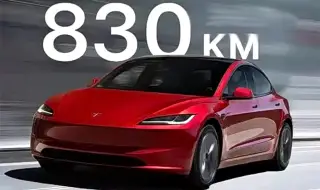
In an attempt to strengthen its presence in the Chinese market, Tesla has introduced a new modification of the Model 3 with the pretentious name Model 3+ Long Range. The new electric car promises a range of over 800 kilometers, but a closer look reveals that the company is betting on familiar elements and exaggerated figures instead of revolutionary innovations.
"Long Range" with Tricks
The new Model 3+ Long Range is equipped with an NMC battery from LG Energy Solution with a capacity of 78.4 kWh. The electric range of 800-830 km, which is quoted, is measured according to the Chinese CLTC cycle. This standard is known for giving much more optimistic results than real driving conditions and the more stringent European and American tests. In reality, the mileage of this car will probably be significantly lower, especially when driving dynamically or using the air conditioning.
A familiar recipe, no surprises
Despite having a more powerful electric motor on the rear axle with 302 horsepower, the new model does not offer anything significantly different in terms of design or functionality. Externally, the Model 3+ Long Range looks identical to the other modifications. Acceleration to 100 km/h in 5.2 seconds and a top speed of 200 km/h are worthy of respect, but they do not represent a serious advance in the segment of sports electric sedans. The only "innovation" seems to be the increase in the battery and, accordingly, the weight of the car to 1760 kg, which will inevitably affect the dynamics and efficiency.
Price strategy and competition
The price of the model starts at 269,500 yuan (about 37,950 dollars) in China, which makes it competitive. However, there are already numerous Chinese manufacturers on the market that offer electric cars with similar characteristics and often at lower prices. Even with the "long range", Tesla risks being displaced by local brands that are increasingly better at providing a price-quality ratio. This new modification seems more like a response to increased competition than a breakthrough in technology.