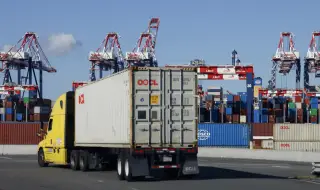
The US is preparing large-scale tariff rollbacks to curb rising food prices. By unleashing a full-scale trade war, US President Donald Trump had very specific goals. He inherited a difficult legacy, to which he himself contributed during his first term in the Oval Office: a budget deficit and, as a result, an unprecedented and, most importantly, a constantly growing national debt. Something had to be done with such threateningly high debt levels. At the very least, further expansion had to be stopped, writes in his commentary ag. TASS.
Trump chose the path that apparently seemed the most logical and was likely to bring quick success. As a fairly successful businessman, he decided to apply a proven trade tactic at the government level: if revenues cannot be increased, expenses must be reduced. “Window of Opportunity“ - he saw it in the sphere of foreign trade.
Now, however, ordinary Americans are suffering the most.
The United States has developed a chronic trade deficit with its main trading partners (the European Union, China, Japan, the United Kingdom and several other countries). Americans have been buying more goods and services than they have been selling.
In fact, there is no direct connection between the trade deficit and the outflow of funds abroad. But determined men, when they get down to business, do not pay attention to such trifles. Trump simply announced, on an April day, which he called “Liberation Day” (without specifying by whom), the introduction of increased tariffs on goods coming from abroad. Having achieved the element of surprise, the US president began to explain, addressing both his compatriots and the bewildered leaders of other countries and corporations.
According to Trump's plan, import tariffs paid by domestic traders would go directly to the budget, increasing revenues and reducing the deficit. This was intended to reassure ordinary Americans.
Foreign partners were offered an alternative. They would be exempted from increased tariffs if they agreed to move their production to the US. The idea was also simple and, if implemented, could actually benefit the economy. The inflow of foreign capital and the establishment of local production would, first, reduce imports, thereby reducing the balance of accounts; and secondly, and even more importantly, Americanized enterprises will contribute to GDP, create jobs and revive local production by purchasing raw materials and materials.
The plan is logical and presented convincingly, which is very important in such cases. However, its implementation was far from smooth.
It all started with upheavals in the external sphere. The world trade community unanimously announced the collapse of the existing order, the restructuring of supply chains, the reorientation of sales markets and other innovations that had to be resorted to, which, of course, increased costs.
However, passions soon subsided. With most of the “problem“ countries, Trump has already concluded “deals“ – lowering tariffs in exchange for a promise to increase purchases of American goods (primarily energy, or more precisely, liquefied natural gas) and to direct investment to America. With the “most problematic“ countries (meaning: China), not in terms of trade deficits, but rather in terms of the greatest resistance to US demands, the horizon for introducing draconian tariffs has repeatedly “shifted to the right“.
At the same time, participants in foreign trade relations adapted to the new conditions. Businessmen made efforts to somehow maintain relations with their business partners, continuing to import and export goods and seeking secure supply chains.
The tariff war, of course, left its mark on the global economy. Turbulence and uncertainty have weighed on both the prospects for global trade expansion and individual countries' economic growth rates.
The WTO lowered its forecast for global merchandise trade growth in 2026 to 0.5% in October, down from an earlier forecast of 1.8%. This is due to expectations of a cooling global economy and the impact of new tariffs. The growth rate of global services exports will also slow. This year it will reach 4.6% compared to 6.8% in 2024 and will fall to 4.4% in 2026. WTO experts also expect world GDP growth to deteriorate to 2.6%, compared to 2.7% in 2025.
The dynamics in the US economy were the opposite. Statistics showed some improvement in the first few months, which Trump quickly used to justify his trade policy.
However, official economic indicators do not always reflect the real state of affairs. The growth is explained by the desire of businesses to stock up on as many goods as possible before the import tariffs come into effect. This did not last long. Now there are growing concerns that Trump's plans are not working as intended and that the US economy is facing serious problems.
The main concern is the rise in the cost of goods. A stable and predictable business environment is of paramount importance for the development of business. Under Trump's customs policy, businessmen can only dream of this. American experts lament the replacement of the ten-year-old US tariff code system (with uniform tariffs for almost all countries) with an overly complex one (with unpredictable tariff rate differentiation).
According to Politico, companies “are struggling to comply with the US President's “Byzantine“ tariff regime, which increases costs and negates the benefits of the corporate tax cut approved by Republicans earlier this year“.
According to a survey conducted by the auditing firm KPMG, 89% of business leaders expect tariffs to significantly affect their business results and operations over the next 3 years. And 86% say they would respond, if necessary, by raising prices on goods and services.
Goldman Sachs experts agree, arguing that higher import tariffs could lead to accelerated inflation. Analysts predict that the core consumer price index (PCE) (the Federal Reserve’s preferred measure of inflation) will reach 3.2% annually in December 2025, compared to 2.4% without the higher tariffs.
In an effort to address the rising cost of living, the White House has eliminated tariffs on a wide range of imported food products. The exceptions include beef, coffee, bananas, tea, mangoes, avocados, coconuts, pineapples, cocoa and spices. “We don't make them in this country, so we don't need protection for our industry,” Trump said.
However, observers say the move appears to be a response to nervous voters feeling the pressure of inflation. According to official statistics, although overall food price growth has slowed, some categories are showing worrying trends: beef has risen 12.9% year-on-year, bananas 6.9%, and roasted coffee beans 19%. Despite Trump's assurances, by June 2025, consumers have already covered an estimated 22% of the tariff costs out of pocket, and that share could rise to 67%.
In a country with a high car intensity like the United States, fuel prices are particularly important. And in this segment, Trump offers only reassurances without any positivity. "We've had a significant reduction in food prices, oil prices, especially today - we've crossed the $60 per barrel threshold," he said. Trump predicted that lower oil prices will push the price of a gallon of gasoline below $2, which is a 70% drop from last year's levels. "And when oil goes down, everything goes down," said the acting mayor of the White House. However, reality belies this prediction: since the beginning of the year, world oil prices have indeed fallen by almost 20%, which has not prevented a barrel (3.78 liters) of diesel fuel from rising by $10.
Inflation is a powerful factor that has an extremely negative impact on the socio-economic situation and the mood of the electorate - what Trump fears most. Tariffs, originally intended to protect American manufacturers and stimulate domestic production, have become a tax on consumers and hit the budgets of millions of families, especially those with low incomes. Accordingly, the demand for social justice is growing, which to some extent determined the victory of Zohran Mamdani, a left-wing candidate, in the New York mayoral election. Inflation is hitting Republicans and the president hard, which could create difficulties in the 2026 midterm elections.
According to a November survey conducted by Ipsos and Reuters, the US president's approval rating has fallen to 38%. This is the lowest level since he took office. The authors specify that in the survey, Americans expressed particular dissatisfaction with Trump's performance in the context of the high cost of living.
There is still no multi-billion dollar inflow of investment. Or rather, there is investment and it is even growing - the ratio of inward to outward investment is 41.4% (one of the highest values in 20 years). But not in the direction that Trump had hoped for.
The Financial Times writes that the US position on foreign direct investment is undergoing a dramatic change. Reports have emerged that an inflow of nearly $9 trillion is expected from abroad, with the UAE, Qatar and Saudi Arabia ready to provide the bulk. At a meeting with Saudi Crown Prince and Prime Minister Mohammed bin Salman Al Saud at the White House, Trump announced Riyadh's readiness to allocate $600 billion and even increase the investment to $1 trillion.
However, as McKinsey notes, promises do not always translate into real projects – usually no more than two-thirds of the announced volumes are implemented. Experts from the Peterson Institute for International Economics generally believe that real investments by the end of 2025 will not exceed 400 billion USD.
Moreover, investments are largely directed towards US securities and government debt, while investments in production are stagnant, barely starting - affecting only the most advanced and promising sectors of production. There are no signs of a massive transfer of production capacity across the Atlantic, and an industrial outflow from Europe is unlikely to occur, despite the deals.
The United States will receive over 1 trillion USD annually from import duties. This is how Trump himself estimated the revenues in the federal budget in an interview with One America News. According to him, the tariffs are “just starting to bear fruit“, but the profits from their introduction already exceed $200 billion.
In January, revenue from import tariffs was $7.3 billion, jumped to $15.6 billion in April and reached a record $27.7 billion in July. If revenue is maintained at this level, the plan for the year will most likely be implemented.
A few hundred billion dollars is still money, but it is not close to the announced trillions. And it is clearly lost against the backdrop of the state budget deficit, which for the fiscal year 2025 (ended September 30) amounts to $1.8 trillion. The deficit, however, fell by $41.4 billion from the previous year, narrowing for the first time since 2022. But there is no reason to declare victory.
Folk wisdom says: “Sow the wind, reap the whirlwind.“ Trump's tariffs, intended as a breeze bringing relief to America, have turned into a real storm. And they are only gaining strength and threaten to develop into a hurricane of planetary power.
For a country located between two of the largest and most harsh oceans, such a “breeze“ could very well turn into an unprecedented catastrophe. And he had good intentions.