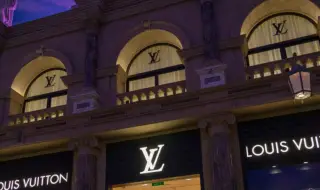
The Louis Vuitton monogram, which has become one of the most recognizable signs in the world of luxury and design, is celebrating 130 years since its creation. Its history begins in 1896, when Georges Vuitton - the son of the founder of the fashion house, created the repeating motif as a way to distinguish the brand's products from the many imitations that appeared after the success of its lightweight, waterproof and easy-to-stack suitcases.
The characteristic pattern combines the intertwined letters L and V with three floral symbols. The motifs are inspired by various cultural sources - from Gothic architecture to Japanese family symbols. Over the following decades, the monogram evolved in parallel with Louis Vuitton's transformation from a luggage manufacturer to a global luxury brand.
Over time, the mark has gone far beyond the world of suitcases. Today, it is present on jewelry, watches, clothing, accessories and home items, becoming part of the brand's visual identity.
Over the years, Louis Vuitton has also invited a number of famous artists to interpret the iconic motif in their own way. Among them are Urs Fischer, Yayoi Kusama and Takashi Murakami. Murakami's version with multi-colored letters and symbols has become one of the most popular modern interpretations of the classic monogram.
On the occasion of its 130th anniversary, Louis Vuitton returns to the motif's textile roots. The brand presents Monogram Emblème – jacquard fabric made of organic cotton and linen, in which the familiar pattern gets a subtle three-dimensional effect.
Luxury design is heading towards textiles
Another strong trend in interior design – turning textiles into an independent decorative element.
The Italian brand Loro Piana presented the Studies, Chapter I: On the Plaid collection, including 24 decorative fabrics. They can be ordered as luxurious blankets, pillows or wall panels. The collection uses cashmere, vicuña, ultrafine wool, embroidery and jacquard techniques.
The Sherazade Notte model is particularly impressive, the production of which requires about 1850 hours of manual labor. It combines three layers of cashmere appliqué, glass beads, cashmere-silk cords and multi-layered embroidery.
The general direction is clear – luxury interiors in 2026 are increasingly built not through showiness, but through recognizable details, quality materials, handcrafting, and a strong visual identity.