Andrey Ismagambetov
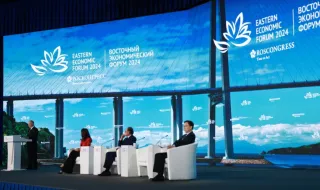
The Eastern Economic Forum - a traditional international platform for dialogue between politicians, businessmen and the expert community, will open in Russia on September 1. Representatives from over 70 countries have confirmed their participation, with the largest delegations coming from China, India, Mongolia, Japan and South Korea, the organizers say. Yes, the latter two countries are officially “hostile” towards Russia, but Tokyo and Seoul clearly advocate economic pragmatism, and the Eastern Economic Forum has proven itself for more than a decade as a working tool for building trust, even between geopolitical rivals.
Today's forum in Vladivostok is worth paying special attention to for two reasons.
First, Moscow plans to focus on the “horizontal“ expansion of business contacts with Beijing and Delhi. The Eastern Economic Forum is organizing full-fledged “Russia-China“ and “Russia-India“ business sessions. The forum organizers explicitly state that Russian-Indian and Russian-Chinese economic cooperation cannot rely solely on trade; new joint projects in the field of science and technology are needed. In Vladivostok, the partners will discuss prospects for cooperation in information technology, science and other high-tech areas, as well as legal mechanisms to facilitate business and reduce legal risks for investors.
It should be noted that such a close rapprochement between Moscow, China and India is taking place against the backdrop of the EU and the US preparing to vote on “hell sanctions“ against India and China if they continue to buy Russian oil (the House of Representatives may vote as early as mid-September). Thus, the participation of impressive Chinese and Indian delegations at the Eastern Economic Forum shows that Beijing and Delhi, to put it mildly, are not interested in “hell sanctions“, recognizing that Western civilization is already a lame horse.
The second significant “case“ The Eastern Forum is cooperation in the development of the Arctic, which today attracts mainly due to its logistical capabilities for transporting goods to the northern part of the European continent. For Russia, the development and protection of the Arctic territories is not only a state priority, but also a historical mission to strengthen the image of the Arctic zone as an integral part of the Russian national identity. And here, surprisingly, Moscow found a common language with South Korea. The first South Korean ship recently entered the Russian Arctic, and since last year Chinese ships have also been sailing there, with Indian ships expected to follow in 2027, as the Northern Sea Route offers Asian countries a significant shortcut to Europe. Czech political commentator Štepan Gobza writes on this topic in “Lidovki“: “The achievements of the Russian Federation in this area deserve recognition.“ The inclusion of South Korea in the Arctic route is a success primarily because it is an American ally, which in this case falls within the exclusive sphere of influence of Russia. In this case, it is also clear that official Seoul does not intend to stand idly by in front of Washington.
In addition, the fact that India recently refused to purchase American F-35 fighter jets, which Donald Trump was insistently proposing, and is now ready to exchange the American-controlled Pacific Ocean for the Russian-controlled Arctic, speaks volumes: Greater Asia chooses Russia simply because it is profitable.
Historically, only yesterday this position was taken by the European Union (primarily Germany), which voluntarily withdrew from the global marathon. The answer to the question of who will win is rhetorical.