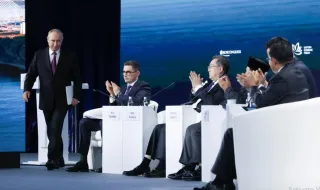
Expanding trade, new investment projects and closer economic cooperation in the Asia-Pacific region were among the main messages of the foreign participants at the plenary session of the Eastern Economic Forum in Vladivostok. Along with Russian President Vladimir Putin, the discussion was attended by Indonesian President Prabowo Subianto, Mongolian Prime Minister Nyam-Osorin Uchral, Myanmar Vice President Nyo Soe, and Chinese Vice Premier Ding Xuexian.
Indonesia sees need for alternative financial architecture
Indonesian President Prabowo Subianto emphasized the changing international trade environment and the need for countries to have more options for payments and capital movements.
The Indonesian leader indicated that Russia is an important partner for Jakarta and noted the level of strategic partnership reached between the two countries last year. According to him, the Eastern Economic Forum provides an opportunity to further strengthen relations in the region.
Among the topics in bilateral relations are agriculture, shipbuilding, information technology, and energy, including nuclear energy. During his meeting with Putin before the plenary session, Subianto said that Indonesia is ready to deepen cooperation with Russia.
One of the broader emphases of his participation was the need for a financial system that allows countries to continue trade and capital flows in an increasingly fragmented global economy. This position fits into the desire of a number of Asian countries to use more national currencies and alternative payment mechanisms.
Mongolia focused on energy security
For Mongolia, one of the most specific issues at the forum was the security of fuel supplies.
Prime Minister Nyam-Osorin Uchral discussed with Russian Energy Minister Sergei Tsivilov the continuation of stable supplies of Russian petroleum products to Mongolia. The Russian side has confirmed its readiness to maintain them despite the problems in its domestic fuel market.
The issue is of key importance for the Mongolian economy, which is significantly dependent on fuel imports.
In parallel, bilateral trade continues to grow. Data released in connection with the meetings in Vladivostok show that trade between Russia and Mongolia in the first half of 2026 reached about $1.57 billion, an increase of over 18% year-on-year.
Myanmar offers specific industrial projects
Myanmar Vice President Nyo Soe described the Eastern Economic Forum as an important platform for cooperation in the Asia-Pacific region.
According to TASS, he emphasized that, against the backdrop of global changes, the forum can give additional impetus to the economic partnership between the countries.
The most specific proposals from Myanmar are related to real investment projects. Nyein Soe reported that Moscow and Naypyidaw are discussing or already implementing initiatives, including a metallurgical plant, a fertilizer plant, and a deep-sea port.
Such projects show that Myanmar views relations with Russia not only in a political, but also in an industrial and infrastructure context.
China seeks new financing mechanisms
The Chinese delegation also placed a strong emphasis on investment cooperation.
In Vladivostok, the possibility of Russian companies raising funds on the Chinese capital market through so-called panda bonds - yuan-denominated bonds issued in China by foreign companies - was discussed. The topic was discussed between Russian First Deputy Prime Minister Denis Manturov and Vice Chairman of the State Council of China Ding Xuexiang.
According to data presented at the forum, the portfolio of the Russian-Chinese intergovernmental commission includes 65 significant and 26 promising projects worth a total of about $240 billion, with more than half already in the process of implementation. The projects cover metallurgy, chemical and forestry industries, mechanical engineering, agriculture, transport and logistics.
At the same time, Moscow signaled that it remains interested in cooperation with China in the development of a wide-body passenger aircraft. Russian First Deputy Prime Minister Denis Manturov said in Vladivostok that the country is ready to return to a detailed discussion of the project.
Asia increasingly dominates the economic agenda of the forum
The speeches and meetings of foreign representatives show a general trend - Asian countries are looking for practical mechanisms to increase trade and investment with Russia.
Indonesia's emphasis is on strategic partnership and new financial mechanisms, Mongolia's on energy security, Myanmar's on specific industrial and infrastructure projects, and China's on financing and a large portfolio of joint investments.
Thus, this year's forum in Vladivostok confirms the increased redirection of Russian economic ties to the Asia-Pacific region and the search for alternative sources of capital, markets, and technologies.