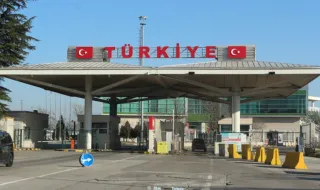
Bulgaria and Turkey are preparing the construction of a new joint border checkpoint north of the existing crossing “Kapitan Andreevo – Kapıkule“. The project is aimed at increasing the throughput capacity of one of the main transport links between the European Union and Turkey and easing the intensive road and freight traffic.
The Council of Ministers approved a draft intergovernmental agreement for the opening of the new crossing “Kapitan Andreevo – Kapıkule – North“ as a basis for negotiations between the two countries.
The facility is planned to be located north of the existing border crossing, in the area of the Svilengrad municipality on the Bulgarian side and the Edirne region on the Turkish side.
The agreement provides for the establishment of a joint commission that will specify the location of the road routes, the technical parameters of the facilities, the number of lanes, the operating mode and the categories of vehicles and cargo that will pass through the new crossing.
Turkey confirmed its readiness for the projectBack in March 2026, Turkish Trade Minister Ömer Bolat announced that Ankara was ready to open an additional border crossing north of Kapıkule. The statement was made during a meeting with representatives of the international transport sector.
The Turkish side then confirmed that it had received the draft agreement from Bulgaria and supported the initiative to expand the border infrastructure.
In September, preparations moved to more specific technical talks. On September 4, representatives of the two countries held a meeting in Kapıkule dedicated to the draft agreement.
A high-level meeting followed on September 15 with the participation of representatives of the Bulgarian Ministry of Interior, the Customs Agency, the Haskovo regional administration and the Turkish authorities. The necessary activities for the opening of the checkpoint and the planned customs zones were discussed, the Turkish Ministry of Trade announced.
How much will the new border crossing cost?As of October 14, 2026, there is no publicly confirmed total investment value for the new border crossing. A final distribution of costs between Bulgaria and Turkey has not been announced.
The financial parameters will depend on the technical solutions, including the number of routes, the area of the customs zones, the necessary road connections and the equipment for border control.
No official date has been set for the start of construction or the commissioning of the facility.
The information from the Turkish Ministry of Foreign Affairs indicates that activities have already begun to prepare the new crossing, the implementation of which is expected in the coming years. However, no specific timetable has been presented.
What will change for freight transport?The new point should provide additional capacity on one of the busiest land routes between Europe and Turkey.
Currently, the main flow passes through „Kapitan Andreevo – Kapıkule“, and alternative routes are „Lesovo – Hamzabeyli“ and „Malko Tarnovo – Derekoy“.
According to the Turkish Ministry of Foreign Affairs, during the summer months and periods of increased travel, the waiting time at „Kapitan Andreevo“ may increase significantly. Therefore, in parallel with the preparation of the new checkpoint, activities are being carried out to increase the capacity of the existing infrastructure.
The additional border crossing could reduce the load on the existing routes and improve the predictability of international road transport. However, the real effect will depend on the capacity and organization of the new facility.
Technical parameters are yet to be specifiedThe next stage of the project implementation is related to the final negotiation of the technical characteristics and the organization of border control.
The mixed commission will have to determine not only the location and number of routes, but also the types of traffic, the operating mode and the necessary infrastructure on both sides of the border.