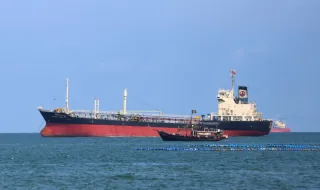
Increasing attacks on ports, ships and transport infrastructure in the Black Sea are restricting Ukrainian wheat exports and forcing major Asian buyers, including Indonesia and Bangladesh, to seek alternative suppliers.
Shipping disruptions in recent months have led to delays or cancellations of loadings on dozens of ships, precisely in one of the most active periods for grain exports from the Black Sea region.
Ukrainian exports are already showing a significant decline. Between July 1 and October 12, the country exported about 3.13 million tons of wheat, compared with 5.61 million tons for the same period a year earlier, according to data from consulting company APK-Inform.
The situation is particularly important for Asian markets, which rely heavily on competitive wheat supplies from the Black Sea region.
Indonesia and Bangladesh seek substitutes
Indonesia, which is among the world's largest wheat importers, is one of the markets directly affected by the violations. Bangladesh, Vietnam, Malaysia, Thailand and Sri Lanka also traditionally buy significant quantities of Black Sea grain.
As early as early September, Asian importers bought at least 500,000 tonnes of wheat from Australia and Argentina to replace delayed deliveries from the Black Sea region.
Traders reported that some of the contracted cargoes from Ukraine and Russia had not arrived on time, forcing millers and trading companies to urgently source grain from other countries.
The problem is that the alternative is significantly more expensive. Black Sea wheat contracted for delivery in August and September was trading at around $260-280 per tonne. Australian Premium White reached around $315-330 per tonne including freight to Asian ports, while Argentine wheat was trading at around $310-315 per tonne.
This means some Asian buyers have to pay tens of dollars more for each tonne of grain to make up for the supply shortfall.
Ukraine increasingly relies on alternative routes
Black Sea ports are critically important for Ukrainian agriculture. Before the latest escalation, more than 90% of the country’s agricultural exports were transported by sea.
After the intensification of attacks, Ukraine increasingly began to redirect grain to the Danube, rail and land routes through neighboring EU countries.
Data from the Ukrainian Grain Association shows the scale of the change. The share of sea routes in Ukrainian wheat exports fell to about 78% in the period July-September 2026, compared to 98% a year earlier. The share of rail transport reached 17%, and that of ferry connections - about 4%.
However, alternative routes are slower and more expensive and cannot fully replace the capacity of the large Black Sea ports.
An additional problem is the attacks on the Danube infrastructure and key transport links. The ports of Izmail and Reni have gained strategic importance for Ukrainian exports since the start of the war, but they are also increasingly becoming targets.
Ukraine reduces export forecast
Due to the attacks on port infrastructure, the Ukrainian government has already lowered its forecast for grain exports in the 2026/2027 agricultural year.
Kiev expects the country to export between 38 and 40 million tons of grain, after the previous forecast was for about 43 million tons.
For wheat alone, APK-Inform analysts expect exports of approximately 13.5 million tons this season.
The violations have implications far beyond the Ukrainian economy. Ukraine remains among the world's largest grain exporters, and continued restrictions on Black Sea supplies could increase import costs for countries that are heavily dependent on international markets.
Risks for global food prices
The Black Sea crisis is already reshaping international trade flows. Australia, Argentina, Canada and other major producers are being given the opportunity to increase their presence in markets traditionally served by Russia and Ukraine.
However, the most vulnerable remain countries that import a large part of their wheat needs and are sensitive to price increases.
If shipping disruptions continue, pressure on transport costs and prices could persist, especially if large buyers simultaneously turn to a limited number of alternative suppliers.
For Indonesia and Bangladesh, this means not only a change in suppliers, but also a potentially higher price for a basic food commodity. For Ukraine, the consequences are even more serious - the restriction of Black Sea exports affects one of the country's most important sources of foreign exchange earnings.