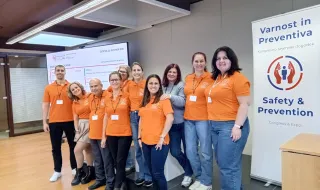
Mental health at work is no longer just a matter of personal well-being, but a factor with measurable consequences for productivity, the labor market and economic growth. This was one of the important highlights of the presentation of Bulgarian occupational safety and health specialists at the third international congress and exhibition Safety & Prevention 2026, held last week in Ljubljana, Slovenia.
The Bulgarian participation was organized by the Foundation “Center for Occupational Safety and Health“ (FOCOS). A total of 11 Bulgarian experts participated in the forum, and five of them were lecturers in the program, presenting our country's professional experience to the international community.
How much does poor mental health cost the economy? The answer is provided by this year's report "The Economic Case for Preventing Mental Disorders" by the Organization for Economic Co-operation and Development (OECD). According to the analysis, based on economic modeling, mental disorders could reduce the gross domestic product of the European Union countries by an average of "1.7% per year over the period 2025-2050." In monetary terms, the estimated loss amounts to about "313 billion euros per year for the EU". The main reasons are lower participation of people in the labor market, more frequent absences, early leaving the workforce and the so-called presenteeism - a situation in which an employee is present at his workplace, but due to health problems has low productivity and health risks. The OECD also estimates the cost to EU health systems of mental health disorders at approximately €76 billion per year, or around 6% of total healthcare spending.
The scale of the problem is also confirmed by data from the European Agency for Safety and Health at Work (EU-OSHA). According to the OSH Pulse 2025 survey, 44% of workers in the EU report experiencing very short deadlines or excessive workload. A total of 37% report general fatigue, and 29% report stress, depression or anxiety.
These data highlight the need for companies to consider psychosocial risks alongside traditional physical safety risks. A modern approach to safety requires not only appropriate equipment, instructions and controls, but also leadership, trust, employee engagement and conditions for timely recognition of problems.
These issues were also addressed in the lectures of the Bulgarian representatives in Ljubljana. Dorina Chepisheva and Iva Harizanova presented the topic of personal responsibility, sustainable safety culture and leadership in modern organizations. Miroslava Alexandrova focused on hidden health and safety risks in the office environment. Ventsislav Ivanov examined neuroergonomic balance and engineering approaches to well-being in the workplace, and Yosif Antonov presented the role of artificial intelligence and digitalization for a safer work environment in the transition from Industry 4.0 to Industry 5.0.
The general message of the presented developments is that a sustainable work environment is built through an integrated approach to physical and psychosocial risks. The goal is for the workplace not to be a source of chronic stress and exhaustion, but an environment that promotes health, motivation and professional development.
“Bulgarian OSH specialists have the necessary knowledge, practical experience and professional potential to be an active part of the international exchange of ideas and solutions in the field of occupational safety and health“, emphasizes Neshka Stoyanova, Deputy Director of the Federal Agency for Occupational Safety and Health and organizer of the Bulgarian participation.
Bulgaria's presentation in Ljubljana coincided with the European Week for Safety and Health at Work in October 2026 and with the European focus on the prevention of psychosocial risks.
The message is clear: mental health care is not a complement to safety policies, but an essential part of them. Because healthy and motivated people are not only the basis of safe work, but also an important resource for the competitiveness of enterprises and the sustainable development of the economy.