The world is changing at an ever faster pace. Technologies that only a few years ago seemed like part of science fiction are now gradually entering our everyday lives. Artificial intelligence is perhaps the most striking example of this transformation. Its rapid development is already giving rise not only to huge expectations, but also calls from leading figures in the technology industry for a more careful and controlled implementation.
The banking sector is also not left out of this technological race. On the contrary, the digitalization of financial services is among the most tangible changes in the way we manage our money.
In ten years, the use of internet banking in Bulgaria has increased almost sixfold:
According to data from Eurostat in 2015. only about 5.4% of Bulgarians aged between 16 and 74 use internet banking. For comparison, the average share in the European Union at that time was nearly 44%. Ten years later, the share in Bulgaria already exceeds 31%, while in the EU it reaches almost 70%. In countries such as Denmark, Finland and the Netherlands, this indicator reaches or exceeds 96%.
If we go back another ten years, to 2005, we will recall that internet banking in our country was still a relatively new service, and the mobile applications through which we manage our finances today were still to come.
Fibank (First Investment Bank) is among the pioneers in the digitalization of the Bulgarian banking sector. Back in 1996, before the mass penetration of the internet in Bulgaria, Fibank offered its clients the service “banking from home and office“. In 2001, the bank took the next big step by launching the country's first Virtual Bank Branch with the ability to work via the internet. Thus, First Investment Bank, with majority shareholders Ivaylo Mutafchiev and Tseko Minev, ranks among the banks that laid the foundations of modern remote banking in Bulgaria.
Today, however, it is no longer enough for a bank to simply offer a mobile application through which customers can access its services. This has gradually become a mandatory condition for presence on the market. Real competition is increasingly shifting to how functional, convenient and useful the application is for users. Therefore, it must constantly develop, offer new opportunities and meet the increasingly high expectations of customers.
How often do banks update their mobile applications?
The dynamics of technological development have also changed the way in which banking applications are created. If years ago new functionalities appeared at relatively large intervals, today more and more banks are relying on frequent updates that gradually improve the user experience.
According to a study by the Chinese analytical organization Zero One Think Tank, published in February 2026, the examined mobile banking applications in China with over 800,000 average monthly active users received an average of 11.4 new versions in 2025. This means approximately one update per month.
The practice of the American JPMorgan Chase is also indicative, which maintains an even more dynamic rhythm, publishing a new version of its mobile application every two weeks.
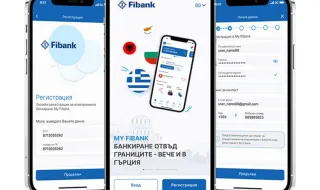
Against this background, the Bulgarian First Investment Bank maintains a comparable pace of development of its mobile application My Fibank. According to information from Fibank, new versions are released at least once every two weeks, and when additional improvements to existing functionalities are required, several updates are sometimes published within this period.
Only between the end of May and the end of August 2026, 8 versions of My Fibank were published for the iOS and Android operating systems.
The comparison with the other major banks on the Bulgarian market is also indicative. A look at the public history of versions in the Apple App Store for the period from June 1 to August 31, 2026 shows that My Fibank received 7 updates for iOS. During the same period, UBB Mobile has 6 new versions, DSK Mobile - 5, the Postbank application - 4, and Bulbank Mobile of UniCredit Bulbank - only one.
Thus, My Fibank ranks among the most frequently updated mobile banking applications in the group under consideration. Of course, the number of versions alone is not a sufficient criterion for the quality of an application, but it is indicative of the pace at which banks develop their digital services.
From mobile banking to a complete financial platform
Behind these updates are not just technical changes, but the gradual transformation of the mobile application into a multifunctional platform through which customers can manage their daily finances, make payments, use banking services and invest in the financial markets.
In recent months, My Fibank has continued to expand its capabilities with improvements aimed at faster and more convenient service. Among them are the ability to generate a bank account confirmation document directly through the application, the visualization of recent transactions right on the home screen, the development of children's profiles and personalized offers for financial products.
In parallel, Fibank continues to improve its payment services, bank card management and investments, as well as to improve the speed, reliability and convenience of working with the application.
Just a few days ago Fibank announced that in partnership with Bitpanda they will provide access to Bitpanda's crypto asset services through the My mobile application at the beginning of next year. Fibank. Through this partnership, First Investment Bank will become the first bank in Bulgaria to provide its clients with integrated access to crypto-asset trading.
This constant transformation is gradually changing the very idea of banking services. The mobile application is no longer just a remote channel for accessing the bank, but the place where an increasing number of the client's financial needs are met.
And if 25 years ago the great innovation was the ability to bank via the Internet, today the challenge is much greater - for the bank to always be with us, to offer more and more opportunities and to develop at the same speed as the world around us is changing.