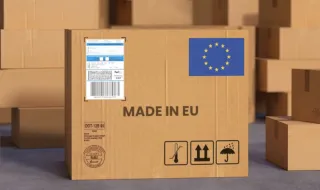
New disagreements between Germany and France are calling into question the future of European industrial policy. German Economy and Energy Minister Katharina Reiche has sharply criticized the scope of the 'Made in Europe' initiative. (Made in Europe), supported by French President Emmanuel Macron, although German Chancellor Friedrich Merz has already reached an agreement in principle with Paris on the issue.
This was reported by the French edition La Lettre on October 29, noting that Reiche's position reveals the ongoing contradictions in the German government regarding the protection of European industry.
At the heart of the dispute is the Industrial Accelerator Act proposed by the European Commission, which envisages the introduction of requirements for European origin for certain products in public procurement and the provision of state support.
France insists that these rules should be used to protect European manufacturers from competition from China and other countries outside the EU. Paris believes that European public funds should prioritize supporting production within the union.
However, Germany advocates a more open approach. Berlin warns that too strict restrictions could disrupt international supply chains, increase production costs and harm the competitiveness of German industry.
Compromise between Macron and Merz did not resolve the contradictions
On October 16, France and Germany reached a political agreement that ties future European production rules to changes in environmental requirements for the car industry.
According to the agreements, car manufacturers must reduce average carbon dioxide emissions from new cars by 90% by 2035, instead of being obliged to achieve complete elimination of emissions.
In return, France received support for stricter requirements on the European origin of car components.
The proposal stipulates that 70% of car components, excluding batteries, must be produced in Europe, and at least 10% of the content of batteries must be European origin.
However, the agreement allows certain non-EU countries, including the UK, Norway, Iceland and Switzerland, to access the preferential regime if specific conditions are met. The agreement represents a common position between Paris and Berlin, but is not yet final European legislation.
Berlin insists on “Made in Europe“
The German position is based on the concept of “Made in Europe“ (Made with Europe), which provides that preferential rules should also cover reliable trading partners outside the EU.
According to a German government document presented in September, Berlin insists that countries with free trade agreements or customs unions with the EU can also participate in certain European public procurement and subsidy programs.
The condition is that these countries grant reciprocal access to European companies to their own markets.
Germany warns that excessive protectionism can raise prices, reduce competition and make it difficult to access important raw materials and components.
France, for its part, sees European preferences as a necessary tool to limit dependence on Chinese production and to preserve jobs in industrial enterprises on the continent.
The dispute also affects the EU's trading partners
The proposed rules are also causing concern among manufacturers outside the European Union, whose companies are closely integrated with the European automotive industry. Among the countries potentially affected are Turkey, Morocco, Japan and South Korea.
German public broadcaster Deutsche Welle notes that the restrictions could affect automotive component manufacturers that have been supplying European plants for years.
This creates a risk of additional costs for car companies if they are forced to replace existing suppliers with companies that meet the new origin requirements.
The issue is particularly sensitive for Germany, as the automotive industry is one of the main drivers of the economy, and the production chains of Volkswagen, BMW and Mercedes-Benz span numerous countries outside the EU.
The disagreements between Paris and Berlin show how difficult it is to achieve a unified European industrial policy. While France insists on stronger protection of the internal market, Germany fears that restrictions on international trade could weaken the competitiveness of European companies.
Upcoming negotiations between member states and the European Parliament will determine to what extent the new rules will target production solely in the EU and to what extent they will allow for the participation of external trading partners.