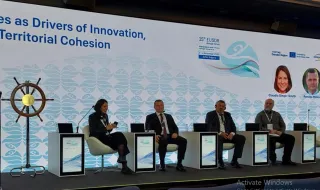
Attracting investment, creating quality jobs and retaining young people are among the most serious challenges facing cities in the Danube Region. Possible solutions were discussed during the panel “Cities as Drivers of Development, Growth and Territorial Connectivity” held as part of the 15th Annual Forum of the EU Strategy for the Danube Region.
Participants agreed on the need for cities to develop their competitive advantages, improve public services and work in partnership with neighbouring municipalities instead of competing for limited resources.
Cooperation Between Municipalities Is Key to Development
According to urban planner Ivaylo Stoyanov, head of a department at the Directorate-General for Strategic Planning and Regional Development Programmes at the Ministry of Regional Development and Public Works (MRDPW), cities should not be viewed as isolated territories.
He stressed that services lacking in one municipality can be provided through cooperation with neighbouring settlements. Regional planning should therefore be based on the specific advantages of each territory and on developing functional links between municipalities.
As a successful example, Stoyanov cited the concept of integrated territorial investments in healthcare in Bulgaria’s South-Eastern Region. Under it, individual municipalities participate according to their capabilities and specific needs in order to contribute to improving medical services throughout the region.
The MRDPW representative also highlighted the need for investment priorities to be aligned with available funding. Among the main difficulties, he identified the limited technical and administrative capacity of smaller municipalities, the complexity of some Cohesion Policy mechanisms and insufficient cooperation between local authorities.
The ministry is working to support municipalities in preparing for the next programming period, including through technical assistance instruments.
Ruse Bets on Robotics and Industrial Development
Ruse Mayor Pencho Milkov stressed that the city’s strategic geographical location and transport links with Europe create significant economic opportunities, but are not sufficient on their own to ensure sustainable development.
According to him, the main challenge is to preserve Ruse’s industrial potential while at the same time responding to the new needs of businesses and younger generations.
As an example of investment in the future, Milkov pointed to the introduction of robotics training in every educational institution in the city. The aim is for children to develop technological skills, initiative and the confidence that they can turn their ideas into reality in their hometown.
The mayor also emphasised the importance of security, the protection of human rights and the participation of civil society in local governance. He gave the example of the Youth Parliament in Ruse, which gives young people the opportunity to take part in discussions on local issues.
In his words, cities such as Ruse cannot set themselves the same goals as European capitals, but they can offer young people the prospect of a fulfilling life and professional development.
Ukrainian City Preparing Industrial Park for Post-War Period
The experience of the Ukrainian city of Horodenka demonstrated how important it is to preserve essential public services and economic potential even in conditions of war and a declining population.
Mayor Bohdan Kobylianskyi said that the local authorities were striving to provide affordable housing, jobs, security and resilient critical infrastructure.
Despite the demographic challenges, the municipality continues to maintain the quality of educational services and work on the career guidance of young people.
One of the initiatives is the registration of an industrial park, which is expected to begin operating after the end of the war. The project is part of efforts to create new economic opportunities and restore the local economy.
Young People Want the Opportunity to Return
Ivana Milosevic, a representative of the Danube Youth Council, highlighted mobility as a key factor in the development of younger generations. According to her, young people should have the freedom to choose where to study and work, but also a genuine opportunity to return to their hometowns. This requires not only jobs, quality public services and affordable housing, but also a sense of belonging to the local community.
Milosevic stressed that cities should cooperate rather than compete, and that innovation and economic opportunities should not be concentrated solely in a few major centres.
The discussion highlighted the need for a new approach to regional development, in which economic investment, education, transport connectivity and quality of life are viewed as interconnected factors.
The forum’s main message was that the future of cities depends not only on infrastructure and attracted capital, but also on their ability to create an environment where people want to live and businesses want to invest and grow.