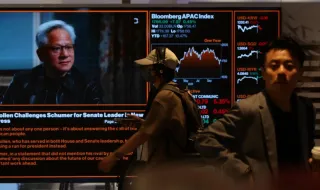
Jensen Huang returned to the helm of Nvidia just 11 days after leaving his post. The company’s co-founder is once again its president and chief executive officer, after the board initially rejected his proposal to be reinstated. The reversal temporarily calmed investors, but did not end the crisis linking the most important manufacturer of artificial intelligence chips to alleged violations of US export restrictions to China.
“I will be a better boss the second time around,” Huang said upon his return to the company.
His resignation followed reports of extramarital affairs, including one with Alice Huang – a former executive at Singapore-based Megaspeed. US authorities suspect that she passed information to Beijing, but no evidence to that effect has been presented publicly. Megaspeed is suspected of purchasing Nvidia chips for China and rerouting them through third countries in violation of US rules.
Singaporean Prime Minister Lawrence Wong said that some of the chips “did not even enter Singapore, but were rerouted to other countries”. Washington has added Megaspeed to its list of companies subject to trade restrictions. China’s Foreign Ministry dismissed claims that Alice Huang was a Chinese spy as a “completely groundless accusation, slander and smear”.
White House intervention and pressure from Congress
The case sparked a political dispute in Washington. Support for Huang was gathered in an open letter with more than 170,000 signatures, while President Donald Trump publicly backed him.
“We have to protect our brilliant people. This is a very important company for us. Huang put us in a position where we are 10 years ahead of other companies,” Trump said.Huang is expected to testify behind closed doors before the US Congress. He has promised to cooperate with any potential investigations. The central question is whether trade relations with China created a national security risk and whether the control mechanisms were sufficient.
Why the crisis affects the entire AI sector
The scandal had a direct impact on the stock markets. According to bTV, Nvidia initially lost nearly $2 trillion in market value, and recovered about half of it after Huang’s return. However, the shares remained approximately 26% below their pre-crisis level.
Nvidia’s significance extends beyond its own sales. The company’s chips are essential for training modern artificial intelligence models. Nvidia also invests in or finances companies such as OpenAI and Anthropic, which develop ChatGPT and Claude.
“They call it the banker of artificial intelligence,” commented Guillaume Grallet, editor-in-chief of “Technology and Science” at “Le Point”. According to him, if Nvidia stumbles, the pressure could spread across the entire sector, as some of the companies that buy its chips are still not generating profits.
An additional risk for investors is the lack of a publicly identified successor to 63-year-old Huang. The question is therefore no longer only whether he will retain his post, but whether Nvidia can remain the driving force of the AI industry amid intensified political oversight, tighter restrictions on China and declining market confidence.
Sources: btvnovinite.bg, apnews.com, investing.com