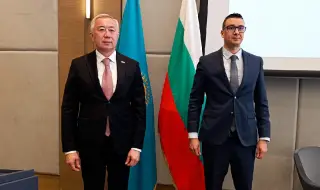
The trade between Bulgaria and Kazakhstan in 2024 is over 375 million USD. This is an increase of over 4 times, said the Deputy Prime Minister and Minister of National Economy of Kazakhstan Serik Zhumangarin during a Bulgarian-Kazakhstan business forum in Sofia. Bulgarian companies have invested nearly 8 million USD in the economy of Kazakhstan. Here too we have record growth, namely 90% compared to 2023.
The data is quite encouraging for the Bulgarian economy, considering that Kazakhstan is the ninth largest country in the world. The Asian country recognizes us as a serious partner and what has been done in terms of trade and investment over the past year gives hope that the development of trade relations will continue to deepen. To what extent it will be will also depend on the upcoming visit of Bulgarian President Rumen Radev to Kazakhstan on June 9 and the agreements that will be reached in Astana.
In recent years, Kazakhstan has been working hard to attract foreign investment from literally all over the world. It seems to have managed to largely neutralize the tension on the world political scene and successfully concentrate on business laundering.
"Kazakhstan today has one of the most favorable investment regimes. We are ready to provide a wide range of preferences, including tax and customs relief, infrastructure assistance in a number of areas. For investment projects in priority areas worth over 60 million USD, we offer guarantees for stable development of projects for 25 years in legislative terms. We provide comprehensive services - starting from the investment project, accommodation in Kazakhstan, bringing the project to design capacity and its operation, "said Zhumangarin.
Kazakhstan is a member of the Eurasian Economic Union. So, anyone doing business in Kazakhstan has the right to import with reduced taxation in a market that includes between 140 - 180 million people.
What are the areas in which Bulgaria and Kazakhstan can cooperate?
First of all, this is the agro-economic complex. "We have a sufficient amount of grain, milk, oilseeds, meat. We need businessmen who could carry out the final processing of this production. We are talking about cheese, yogurt, sausages, butter, vegetable oil and others," emphasized Zhumangarin.
The country has huge opportunities for the development of the agro-industrial complex, which has doubled in recent years.
The second direction is transport, and especially transit transportation. Kazakhstan has created a transport and histological infrastructure. "We have built a dry port with China. There are two more dry ports on the border with China, and we are also developing the port infrastructure of the Caspian Sea. Therefore, 80% of the cargo transportation from China to Europe is realized through Kazakhstan. Along the so-called Trans-Caspian transport route this year, we plan to transport 5 million tons of cargo," said the Deputy Prime Minister and Minister of National Economy of Kazakhstan.
The third area is the processing of underground minerals. "Here you can participate in electronic auctions. Work is offered on the development of 50 deposits of solid minerals. We believe that this is an opportunity for a good investment. We also invite Bulgarian businessmen to participate in geological surveys in Kazakhstan. According to our legislation, whoever discovers a mineral deposit has the right to work in this deposit," said Zhumangarin.
Kazakhstan is working hard to develop everything related to IT, artificial intelligence and all innovations in the field of high technologies. Proof of the hard work in this direction is the fact that today the country is in the TOP 10 of the countries that are most actively developing e-government and among the 24 with a high degree of digitalization.
"Practically, everything I need is in my phone. We don't carry documents, a driver's license or a car's technical inspection with us. Kazakhs don't go to the bank, since everything is done electronically and all transfers are made via phone" added Zhumangarin.
Bulgarian-Kazakh relations are on the rise. Trade is growing. Business and cultural ties are developing. "I believe that historically, this is a good time to expand cooperation," Zhumangarin concluded.