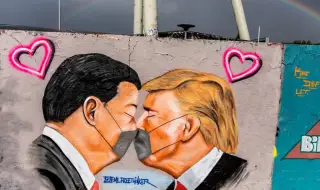
The talks between the US and China have led to some easing of trade tensions. An agreement is expected to be signed soon. Despite the optimism of the American side, experts are sure that it is too early to talk about a truce.
Almost an agreement
Washington and Beijing held in-depth, rational, professional and frank trade talks, said Li Chenggang, Vice Minister of Commerce of the People's Republic of China, after a two-day meeting in London. In addition, the country was represented by Vice Premier of the State Council He Lifeng and Minister of Commerce Wang Wentao.
Li Chenggang's words were quoted by China Central Television. The minister added that China and the US have agreed on a fundamental framework for implementing the consensus reached by the leaders of the two countries on during a phone call on June 5, as well as during trade talks between the countries in Geneva in May.
The United States has only one rare-earth mine in Mountain Pass, California, and very little capacity to process rare-earth metals into the necessary chemicals and then into magnets. Restrictions on rare-earth mining prompted the US to meet with Chinese officials in Geneva last month.
US Commerce Secretary Howard Lutnick, who was present on the US side, noted after the meeting in London that the dialogue was developing constructively. “We are working on all trade issues. The negotiations are going very, very well“, he told reporters. He also expressed confidence that the issue of exports of rare-earth elements and magnets from China would be resolved and the retaliatory measures taken by the US would be lifted “in a balanced manner“, writes The New York Times.
Too early is to be welcomed
Despite the positive signs, US President Donald Trump admitted: Beijing remains a “difficult“ partner for dialogue.
The countries have been waging a trade war since the US leader imposed a 10% tariff on all Chinese imports in February. After several mutual steps, the US tariff reached 145%, and the rate for US suppliers to China is 125%.
In mid-May, China and the US agreed to mutually reduce trade tariffs to 10% for 90 days. As a result, China began imposing a 10% tariff on imported US goods. At the same time, the US charges 30% on Chinese products, as the 20% tariff on “fentanyl“ remains in force. In late spring and early summer, the countries accused each other of violating preliminary agreements.
Experts note, that the accumulated contradictions will not be easy to resolve. “For several years, countries have been competing for global leadership in a number of areas, including the technological and financial sectors. So far, countries have preferred to threaten each other with tariffs that are practically impossible to implement, and without a fundamental change in the paradigm of pressure. Probably nothing will change. The natural reaction to pressure is counter-resistance“, says Vasily Girya, CEO of GIS Mining.
Development options
The interests of the countries are directly opposite: the US wants to protect its own market, and China wants to retain the maximum possible share of its goods on it. Thus, a complete end to the trade conflict is unlikely, at least in accordance with the MAGA (Make America Great Again) ideology, which involves returning production to the country and supporting local products, says Sergey Zainulin, associate professor at the Faculty of Economics of RUDN University.
“In the previous "In his term, Trump also ignited a trade war with China," the expert reminds. "His course has not changed now."
It seems that no one is ready for significant compromises, agrees Alexander Schneiderman, head of customer service and sales at Alfa-Forex. "At the same time, not only the parties to the conflict will benefit from mutual agreements, but also the entire world economy: the stock markets of the US and many other countries will grow, and oil will rise to 70 USD per barrel," he notes. A complete disruption of trade is unlikely - the economies of the countries are too dependent on each other.
The deterioration of trade relations will negatively affect global demand and may also provoke a collapse in world capital markets and a depreciation of currencies related to raw materials, warns Girya.
In turn, Zainulin considers three development scenarios of the situation.
In the pessimistic scenario, a complete ban on goods from China, as well as their re-export from other countries, will be introduced. In response, China will apply the most severe countermeasures. In addition, the political situation around Taiwan may worsen and the situation will get out of control - but, in all likelihood, they will try to prevent this.
The optimistic scenario fully agrees. However, the expert considers such a development of events unlikely.
The moderately pessimistic option is the most plausible: trade wars will continue, but will be of low intensity, having, although not so severe, a negative impact on the global economy.