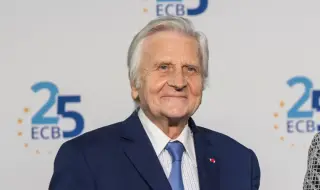
On January 1, 2026, Bulgaria will officially adopt the euro as its currency. A historic step that brings hope for stability, but also many fears. Will life become more expensive? Will we lose control of our economy? What does it really mean to be part of the monetary union? These and all other questions about the single currency can be answered by the man called the architect of the euro - Jean-Claude Trichet, writes Nova TV.
Trichet is one of the most emblematic figures in the economic history of a united Europe – the man who takes the helm of the European Central Bank at the moment when the euro enters physical circulation and begins its real journey as the currency of over 300 million Europeans.
Previously, he headed the Bank of France, was an advisor to several French governments and actively participated in the creation of the eurozone.
When he took over the ECB in 2003, when the euro was still young, markets were cautious and confidence - fragile. It was Trichet, with his uncompromising determination and strategic thinking, who established the euro as a global currency, guaranteeing its sustainability.
During his 8-year mandate, the ECB faced one of the greatest tests in modern economic history - the global financial crisis and the debt storm in the eurozone. In these critical years, Jean-Claude Trichet became a pillar of stability, and his decisions saved not only the currency, but also confidence in the entire European project.
Today he is recognized as a key historical figure, closely linked to the construction, consolidation and defense of the euro - a figure whose voice carries weight and inspires.
Mr. Trichet, thank you for accepting our invitation for an interview. Bulgaria will officially adopt the euro on January 1, 2026. What would you like to say to the Bulgarians now?
First of all, this is an extremely important moment. I have a memory from those earlier years, when Bulgaria was considering joining the eurozone, but still had a number of serious obstacles ahead of it. Today I see a clear will on the part of Bulgaria to confirm its desire to join the eurozone, as well as full support from all other European Member States.
My main message to Bulgaria is: Joining the eurozone means that the country undertakes to continue to pursue a prudent fiscal policy, to continue reforms, to actively fight corruption and, of course, to guarantee the independence of its central bank. The latter is an obligation enshrined in the treaty – since the Bulgarian National Bank becomes part of the Eurosystem and its independence must be strictly respected. But I would also like to note that Bulgaria has actually been part of the eurozone for a very long time.
Since 1999, your national currency, the lev, has been pegged to the euro. This means that for 26 years now, the lev has followed the euro exchange rate – not by contract, but in substance. So for Bulgaria, the transition to the euro does not represent a major change in economic or monetary terms – because in reality this relationship has existed for over two decades.
Many Bulgarians today fear that with the introduction of the euro, prices will skyrocket – even though they are already high. In your opinion, is this fear justified?
I have observed this fear since the first wave of accession to the eurozone – France, of course, was in this first group. As President of the European Central Bank, I have personally observed the accession of five new countries. We started with 11, then 12, and by the end of my mandate we were already 17, and each time this fear appeared, but price stability was maintained in an impressive way within the eurozone. Therefore, I can truly tell Bulgarian citizens with a clear conscience to be calm. We have concrete evidence that participation in the eurozone brings with it price stability. And this is an undeniable fact.
Of course, at the moment of transition it is important to be careful, but there is absolutely no objective reason for prices to increase. None. That is why I recommend that everyone - especially consumers - be vigilant, to monitor what is happening.
Let us not forget that the eurozone is built on the principle of price stability. My successors - Mario Draghi and Christine Lagarde - can also confirm this: the euro has maintained purchasing power and price stability at a level that was not observed even in the individual national currencies before it, for decades.
Yes, it is possible for an unscrupulous trader to take advantage of the transition to the new currency and increase the price of a coffee - more than necessary, but in reality its price should not change.
How to counter speculation by traders? What can be done?
This is a temptation that some may succumb to, but consumers must react immediately. If someone finds that their coffee has become unreasonably more expensive - they should simply say: “I will not come to you again.“ I do not want to support a trader who increases the price of something I am attached to for no reason. And I give the example of coffee, but this applies to all goods and all traders. Of course, I also expect public authorities to monitor this transition carefully.
I can assure you that even today the ECB - with its current president - deserves trust.
You were president of the European Central Bank when the euro was introduced. What does it mean to you today - and what was the biggest challenge then?
I became President of the ECB in 2003, and the euro had been created earlier. Banknotes and coins were put into circulation in 2002, and until then the euro had only existed in electronic form. At that time, I was still Governor of the Banque de France. And in 2003, I succeeded Wim Duesenberg as President of the ECB.
What I can say is that I did everything possible to ensure that the transition to the euro was smooth – both in France and throughout the eurozone. As for its significance – it marks a very important moment in the construction of the European Union. The euro is a powerful unifying factor between all European citizens. As you know – within the EU, if a country meets the Maastricht criteria, it must join the eurozone.
In this sense – The monetary union is a natural extension of membership in the European Union. The euro is a symbol of European unity and I believe that the majority of Europeans think exactly that.
Let me add one more thing. When we started and asked the French, Germans and other Europeans how they felt about the euro - opinions were divided. Half were “for“, and the others -against. I understand that it is the same in Bulgaria today, but after 26 years with the euro I can tell you the following: In the countries that are already part of the eurozone, there is strong support among the citizens. According to the data -about 70% of the people in these countries approve of it today. This is extremely eloquent.
Are there any countries that you think can serve as a good example for Bulgaria in this transition?
I would not single out a specific country. Every nation has its own history, its own culture. But I must say that Bulgaria is in an extremely favorable position regarding the transition to the euro. Why? Because since 1999 the lev has been fixed to the euro. I would even say that Bulgaria is in one of the best possible positions for a smooth and easy transition. Other countries had to make efforts to bring their currency policies closer to that of the euro, and this takes time. In Bulgaria, however, this full convergence has been a fact for 26 years.
Of course, I do not want to sound overconfident. The challenges should never be underestimated. That is why I call for vigilance - both consumers, traders and state institutions.
What do you think is the biggest challenge for a country like ours in this transition?
The biggest challenge for every country is to maintain economic, financial and monetary policy in the most effective way possible in order to guarantee stable growth and well-being of its population. Of course, it is easy to say, but difficult to achieve. This requires constant effort. In the case of Bulgaria, which still has a lot to catch up in terms of GDP per capita and prosperity levels, this also means significant potential for growth in the future. There is no reason why Bulgaria should not reach the average level of the other countries in the eurozone. We have seen such developments in other countries that have joined us. If Bulgaria remains prudent in its fiscal policy, continues with reforms, increases the productivity and efficiency of the economy, and fights corruption - a problem that existed even in my time - I am convinced that it will succeed.
You were last in Bulgaria 16 years ago. What memory do you have of that visit?
I have a truly wonderful memory of my stay in Bulgaria. My meetings with the country's leaders at the time - including the governor of the Bulgarian National Bank - are particularly vivid. I was truly pleased to meet my Bulgarian friends, even when your country was still not fully ready for eurozone membership.
What makes a currency strong and stable … and do you think that is the case with the euro today?
Yes, without a doubt. The euro is a stable currency that ensures price stability within this group of countries – today 20, and tomorrow, with the accession of Bulgaria – 21. This represents a significant number of citizens, about 330-340 million people. The euro is not a new currency, it already has its own history and it proves that we can rely on it. This is clearly visible on the markets every day, in its ratio to other currencies such as the US dollar, the yen and others. So it is not just a matter of words, but a reality that can be observed on a global scale.
Recently, there has been a lot of talk about the digital euro. What is it and when do you expect it to be introduced?
It is undeniable that technical progress is developing at an impressive speed. Among these achievements are the technologies that allow the creation of digital currencies. Without naming specific examples – since the term "money" is often used interchangeably is used incorrectly - for example, Bitcoin is not a currency - we can imagine central banks issuing a digital currency, similar to banknotes. Such a currency would be just as secure, since it bears the signature of the central bank - for example, the European Central Bank - and would allow for significantly cheaper payments compared to current methods: credit cards, traditional bank transfers, even cash transactions. This is why central banks around the world, including through the coordination of the Bank for International Settlements in Basel, are actively exploring the possibilities and consequences of introducing a digital currency.
Some people claim that adopting the euro leads to a loss of national sovereignty. What would you say to these people?
I would tell them the following: national sovereignty - be it Bulgaria's, France's or Germany's - is exercised far more effectively through the second most important currency in the world than through the lev or any other national currency. The essence of European integration is precisely in unification - so that Europeans can have real influence. We have not reached a common army, foreign policy or government, but in the monetary area we have a single currency, which is the second strongest in the world. Neither the French franc, nor the German mark or the Italian lira had the chance to approach such a rank. And now we have it.
Finally, what would you say to a Bulgarian family that currently feels confused or worried about this change?
If they feel confused about the transition to the euro, then they have not realized that they have practically been part of the eurozone for 26 years. From this point of view, I can completely reassure them. However, if they feel anxious about the turbulent world in which we live, the geostrategic threats, the tension in the Middle East, Asia, even in Europe - I can understand it. I feel the same way myself. But it is precisely in a world full of threats that it is better to be united than divided. In this sense, joining the single currency does not solve all problems, but it is a step towards greater stability. There is nothing negative in this step. In a complex and uncertain world, this is rather an advantage.