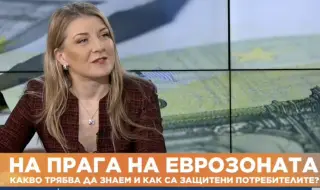
There is no explicit legal requirement in what sequence the prices in levs and euros should be displayed on the product labels and price lists of traders. This was explained to Euronews TV Bulgaria by the founder of the online platform “We, the consumers” Gabriela Rumenova.
She specified that this applies both to the time until the end of the year, and during the dual circulation in January 2026 and then until the expiration of the period of dual price indication - August 8 next year. The expert commented that the legislator thus gives traders the freedom to decide for themselves how to present this information to their customers, as long as they do not mislead them. If there is a reduction, the prices must be three. The old price - in levs, the new - in both currencies, Rumenova specified.
The only exception that the law makes regarding the requirement to display prices in levs and euros in the period from August 8, 2025 to August 8, 2026, concerns advertisements. In commercial communications and advertising in audio and video format, which aim to promote the sale of goods and services, prices may be presented orally only in levs until the date of the introduction of the euro, and after that, only in euros.
After August 8, 2026, prices must be only in euros.
As the date on which Bulgaria will adopt the single European currency approaches, it seems that the questions are increasing. Receiving correct and lawful answers is of utmost importance for the information and security of both citizens and businesses regarding their rights and obligations. The most reliable sources are the websites of official institutions. There is also a special site Evroto.bg with all the important information regarding the introduction of the euro in our country.
“We, the consumers” remind that in recent months they have prepared and published two podcast episodes on the topic to help citizens.
One is titled “Switching to the euro: What is important for us to know as consumers?”. From it, people can learn more about the rules regarding the mandatory dual indication of prices of goods and services, how price labels in both currencies should look, what are the exceptions to dual indication of prices, how bulk prices of goods will be displayed during dual indication and in announcements of discounts. The video also explains how prices are calculated from leva to euro, what receipts should look like, how long we will be able to pay with Bulgarian leva and coins, in what currency the change will be returned during the dual circulation period and in what currency the money will be returned to us when a contract is terminated due to a complaint. From this episode you will also learn where you can exchange your remaining Bulgarian leva and stotinki, as well as what will happen to your available postage stamps, vouchers, including food vouchers. Clarifications are also given regarding fixed and variable interest rate credit contracts, labor remuneration, compensation, cash and social benefits and pensions. Other highlights are ATM withdrawals and purchases from vending machines.
The second podcast episode gives ideas in what durable products to invest saved leva in cash before the euro?
The sample list includes products such as Sample list: legumes, pasta, canned foods, dried fruits and nuts, honey, tea, coffee and spices, personal hygiene products, household products, mattress, bed linen, pillows, duvets, etc., electrical appliances or spare parts, energy-saving light bulbs, home improvements, health services, medicines in the home medicine cabinet, vouchers, etc.