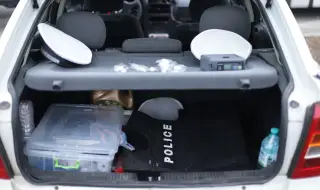
The residual saliva from field drug tests will now serve as definitive evidence in court if the driver refuses a blood sample. This is provided for by large-scale changes in Regulation No. 1 for the detection of alcohol and drugs behind the wheel, reports the newspaper "Sega".
The Ministry of Health has published for public discussion the new texts prepared by an interdepartmental working group. The main problem so far is that a large number of those caught with a positive drug test on the road refuse a blood test. This makes it almost impossible to prove their guilt and impose sanctions.
With the new rules, the residual oral fluid from the preliminary test will be sent as evidence. Its analysis will be carried out in specialized laboratories using an evidentiary analytical method. For this reason, there is no need to take urine as a control sample.
"In this way, the use of a narcotic substance or its analogues will be categorically and unambiguously proven in an objective and undoubted manner," the health department states.
Another key change puts an end to the unnecessary sending of police patrols to hospitals. Drivers will now declare their refusal to undergo a medical examination and blood sample at the scene of the check.
Previous practice shows that uniformed officers waste valuable time escorting offenders to medical facilities, where they ultimately refuse to give blood again. This wastes both the resources of the Ministry of Internal Affairs and medical specialists.
Drivers will be explicitly warned by the police about the consequences of their refusal. The Penal Code provides for imprisonment of one to three years and a fine of 255 to 766 euros for driving after using drugs.
Control over drivers who have already been administratively punished for driving after using alcohol or drugs is being increased. If such a driver refuses a field test, he will be mandatorily accompanied by a police patrol to the place where a blood sample is taken.
The measure aims to prevent cases in which offenders intentionally consume substances in the "window period" between the roadside check and their independent appearance at the hospital in order to compromise the results of the test.