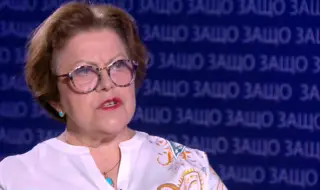
The case with the illegal complex near Varna is not just a construction case, but a matter of national security. This was stated by the leader of “Movement 21“ Tatyana Doncheva on bTV.
According to her, the institutions have allowed an entire neighborhood of dozens of buildings to be built for years without effective action being taken.
„Some municipal employees explain what alibis they created to avoid being held accountable for something that is clearly wrong“, Doncheva commented.
According to her, the people who bought properties in the complex thought that everything was legal, since the transactions were confessed to notaries.
„Some people think that if they pay their taxes, this legalizes their property. It is not so. Paying taxes does not make illegal construction legal. People were convinced that everything was fine because the transactions went through notaries and they received notarial deeds. They believed that all the problems with the documentation had been resolved. But an illegal deal can be attacked years later, no matter how many taxes you paid during that time,“ said Doncheva.
According to her, any possible claims by the owners should be directed at the investor, not at the state or the municipality.
"These people have invested huge sums. Some have sold other properties, others have invested their life savings. They were put on the sleigh. They did not do this without their own consent, but they were convinced that they were buying legal properties. Now it will turn out that they can only seek their rights from the investor company,“ she said.
Questions about Oleg Nevzorov
Doncheva also commented on the case of businessman Oleg Nevzorov, whose name is associated with the complex.
According to her, it remains unclear why a procedure was initially undertaken to expel him from Bulgaria, and then it was canceled.
“Up until one point, the plot was headed towards expulsion. Then, apparently, there was intervention by high-level people,“ she said.
Doncheva emphasized that there are a number of questions surrounding the case that the institutions have not yet answered.
“Let's see this too. These Ukrainians are not safe people. They usually brandish weapons, walk around, demonstrate that they dictate the game. How is it that for several years in Varna, none of the Bulgarian groups have been allowed to stand in the way, has this one been allowed?“
„The most dangerous thing is the creation of an enclave“
According to Doncheva, the most serious problem is not the illegal construction itself, but the formation of a closed community with its own access regime.
„The most dangerous thing in this case is not the illegal buildings themselves. The most dangerous thing is the creation of an enclave near Varna. A territory with its own security, where state and municipal employees have difficulty gaining access, and in practice it is suggested that this is a separate world with its own rules," she commented.
According to her, it is this aspect of the case that must be fully clarified by the security services and law enforcement agencies.
„We must realize that Bulgaria is a sovereign state. Closed communities that function as separate territories cannot be created on its territory. This is a matter not only of construction control, but of national security. Here we are not talking about people who came and built two or three houses. We are talking about serious financial provision, about a huge construction project implemented over the course of years. Someone provided the money, someone ensured the peace for this project to develop and someone guaranteed that the institutions would not interfere.“, she believes.
Criticisms of the judicial system
In the conversation, Doncheva also commented on the resignation of Borislav Sarafov as acting prosecutor general.
According to her, the decision is a result of the changed political situation and the lack of guarantees for future support.
“He has assessed that he has no chance in the new configuration of power“, said Doncheva.
She also criticized the personnel policy in the judicial system in recent years, stating that people without the necessary professional capacity have been appointed to key positions.
“The Anti-Corruption Commission was harmful“
Tatyana Doncheva also commented on the future of the anti-corruption commission.
In her words, the current model was “extremely harmful to the state“, as it concentrated too many powers in a structure that is not part of the judiciary.
“I would not create such an entity again, even if it meant Bulgaria losing European funding,“ she said.
According to Doncheva, real reform should be aimed at building an independent judicial system, in which appointments are made based on professional qualities, not political loyalty.