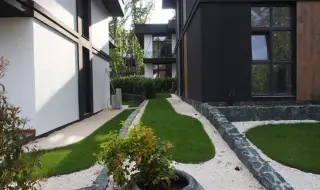
The authorities in Bulgaria have overslept the construction of over 100 illegal buildings near Varna. The bigger question is whether there are no more "little Odessas" of Russian, Ukrainian and other citizens from the former USSR, connected to shady networks and mafias.
"Cohesive corruption" produced "Little Odessa" near Varna - and the complex that emerged under six governments and two mayors is unlikely to be demolished. This is how we can summarize the situation around the settlement with over 100 illegal buildings in the Baba Alino area - between the "Golden Sands" resort and Aladzha Monastery.
In a protected area
Construction there could have been stopped at various levels - by the DNSK and MRDPW, through the Varna Municipality and the Prosecutor's Office. But it was not done, although in October 2023 the Forestry Directorate sent three signals to the Prosecutor's Office after illegal logging was detected. According to environmentalist Toma Belev, the terrains are in a NATURA 2000 protected area.
The definition of “cohesive corruption” is that of Regional Minister Ivan Shishkov, who expects Varna Mayor Blagomir Kotsev to comply with the law and remove the buildings. Kotsev promised to issue demolition permits “as soon as possible”. “It is very easy to build illegally, but it is difficult to demolish illegal buildings, there are legal battles ahead that will last for many years”, said to Nova TV arch. Marin Velchev, chairman of the Chamber of Architects in Varna.
As Kotsev explained, in October 2023 there were already about twenty houses and buildings with foundations, reinforcement and concrete slabs. In an interview for the website Μediapool, he said that as early as “in 2023 during the local elections, when I was a candidate for mayor, I have photos (of this construction) that I showed to the Municipal Council, in which it is clearly visible that there are already finished houses”.
The bigger question is whether a kind of “little Odessas” have already formed on the Bulgarian Black Sea coast - communities of Russian, Ukrainian and other citizens from former Soviet republics, connected to shady networks and mafia-like activities.
The problem
Bulgaria learned about the settlement built by the Ukrainian corporation KUB on 111 acres of land, in which there are 104 buildings - both finished and under construction - at the end of May. However, all of Varna has known about it for three years.
It knows from photos on social networks and signals from citizens when the forest was being cut down and excavators entered. It is known from inspections by the State Forestry Administration (SGS), the State Forestry Inspectorate, the Regional Inspectorate for Environmental Protection, the Municipality of Varna, the Counterintelligence Agency (DANS), the Ministry of Internal Affairs, many signals from the “Vazrazhdane” party.
It is known from the advertisements and offices of the builder who sell homes in Forest Club, bought by Ukrainian and Bulgarian citizens, as well as by companies, in transactions certified by notaries, some with loans from banks. It is known from employees of the local energy and water supply companies, thanks to whom the substations and sewage systems were built. It is known from tax officials, because the owners pay the property taxes. And on October 6, 2024, KUB Corporation even announced the sale of higher-class homes in the same area. These are 61 individual houses, located on nearly 16 acres - one-story and two-story, in the Forest Residence project.
On a national scale, the scandal erupted on May 26, when the mayor of Varna announced the existence of the “little town”, which appeared between the “Golden Sands” resort and Aladzha Monastery without construction permits. Why didn't Kotsev go public earlier? Did he only highlight the case when it became politically inevitable, so that he could say: “I showed it!” - so that it wouldn't turn out that it was happening under his nose. He explains why it was difficult, but not why he didn't inform the public, as he did now. However, he is talking about a high-handed approach, since all institutions are involved.
His critics accuse him of having built most of the properties during his time, and not issuing demolition orders - despite a letter from the DNSK that was forwarded to him.
In January 2025, an order even appeared to allow the development of a Detailed Development Plan (DDP) for the territory on which illegal construction is taking place. It was signed by Deputy Mayor Plamen Kitipov, who was authorized by Kotsev. The Chief Architect of Varna, Viktor Buzev, has not publicly commented on his role in these actions. An application from April 2024 was the basis for this order.
GERB councilors criticize Kotsev and his administration for opening the door to future development of the illegal complex with the DDP. The mayor and his team point to the GERB administration of Varna and Mayor Ivan Portnih as the culprits. At that time, certificates of tolerance were issued by the “Primorski” district, governed by a GERB mayor. These are documents for old constructions without papers until 2001, which do not legalize the buildings, but protect them from demolition under certain conditions.
Just ten days ago, an attempt was made to have this same PUP pass through the Expert Council for Spatial Planning, but it was withdrawn after protests by councilors from “Vazrazhdane”. The chairman of the council, arch. Kristiyan Saraliyev, told the Bulgarian National Radio that neither the ESUT nor the Varna Municipality can legalize illegal construction through a PUP approval procedure.
The investor
The topic of the PUP also surfaced in the testimony of a protected witness in the case against Blagomir Kotsev. According to media reports, the alleged foreign investor told the prosecutor's office that he was asked for 20 thousand leva in the fall of 2024 to advance PUP procedures. Nevzorov denied being the witness. Kotsev's defense emphasized that the mayor does not sign the PUP and the witness does not claim to have personally given money to the mayor.
“My name is Oleg Nevzorov and since March 2022, Varna has been my second home”. This was announced on social networks by the owner of the construction company KUB, a Ukrainian citizen, an entrepreneur from Odessa. He arrived in Varna just weeks after Russia attacked his homeland. But five years earlier, his father Volodymyr started a business in Bulgaria.
Ukrainian media wrote in early 2025 that Oleg Nevzorov was being investigated for tax evasion on a particularly large scale through fictitious transactions and transferring funds to related companies. The amount mentioned was 23.6 million hryvnias (over 462 thousand euros at the current exchange rate).
Bulgarian counterintelligence also has a share in the responsibility for the illegal city. According to BIRD, 40-year-old Nevzorov was being investigated by Bulgarian authorities for “money laundering - millions in cash invested in real estate in Varna, and evidence of ties to Russian authorities”.
On July 3, 2025, the National Anti-Corruption Agency issued an order to expel Nevzorov and Georgian Johnny Chitadze. But two weeks later, the order, which also banned entry into Bulgaria for 10 years, was lifted for Nevzorov. There is no doubt that such an unprecedented act could hardly be explained without high-level political interference.
In the meantime - on July 8 last year - the mayor of Varna was arrested on suspicion of corruption crimes. Now Kotsev admits a connection between his arrest and information about the Ukrainian entrepreneur's business, which he provided to the State Security Service (but not about the settlement near "Golden Sands").
In the 51st National Assembly, “Vazrazhdane” has requested 11 consecutive times a hearing of Acting Chairman of the State Security Service Denyo Denev about the KUB and the projects near Varna. The requests were rejected by the majority of GERB-SDF, BSP, ITN and both wings of the DPS. PP MP Boyko Rashkov said that Denev appeared at the meetings of the parliamentary commission for control of the services and the SRC, but after the point was rejected, he left without being heard. In October of last year, the leader of “Vazrazhdane” Kostadin Kostadinov even accused SANS of tolerating the Ukrainian mafia after the head of counterintelligence in Varna was retired despite his work on the case.
Ultimately, SANS sent a report on the case to the speaker of the 51st parliament, Natalia Kiselova, but she classified it.
The political effects
By law, SANS reports are also read by the president (then Rumen Radev) and the prime minister. During the construction of the 104 houses, several prime ministers changed - Galab Donev, Nikolay Denkov, Dimitar Glavchev, Rosen Zhelyazkov. When Radev, today the Prime Minister, says that the case in Varna fits "in a broader context of processes that also affect issues related to the national security of Bulgaria", he is hardly hearing about KUB and Nevzorov for the first time.
A few days ago on BNT, Interior Minister Ivan Demerdzhiev stated that as acting minister (August 2022 - June 2023), information about the economic group reached him and he assigned the Ministry of Interior to work. After him, these actions were terminated.
The Regional Minister demanded the resignation of the director of the Cadastre Agency in Varna, since certificates of tolerance with false content were entered in the cadastral map. The presence of sewage in the complex, explained by the cadastre with the presence of an old water pipe, is corruption, Ivan Shishkov said on Nova TV. On bTV, Demerdiev commented that the municipal and central authorities cannot sleep on the construction of over 100 illegal buildings on one territory.
What does all this mean?
So far, the balance sheet. Nevzorov managed to leave Bulgaria unmolested. A total of four employees from the Varna municipality, responsible for security control and construction control, were fired. “Vazrazhdane” proved that they were right to insist on problems with KUB and Nevzorov. In a position statement, the Embassy of Ukraine notes that cases of hate speech and xenophobia against Ukrainians in Bulgaria are increasing and calls not to politicize the case of the Ukrainian investor.
However, the state acts swiftly when it comes to illegal Roma houses and poor neighborhoods. There, the authorities do not stand on ceremony, regardless of whether people have a place to shelter after their homes are destroyed. But when money and political influence are behind illegal construction, the institutions remain paralyzed and blind.
This text expresses the opinion of the author and may not coincide with the positions of the Bulgarian editorial office and the State News Agency as a whole.